The Maze Balance Board review examines a children’s wobble toy that combines balance practice with a ball maze, offering screen-free movement for kids ages 3 and up.
Is Maze Balance Board worth it?
It looks most suitable for families wanting indoor coordination play rather than a simple stationary game.
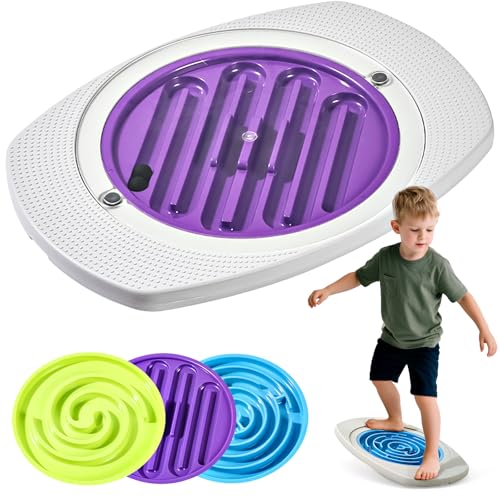
Maze Balance Board Review Summary
The Maze Balance Board is worth considering because it turns a basic balance board into an active problem-solving toy: children tilt and wobble the surface while guiding a ball through a labyrinth.
That combination gives it a clearer purpose than a board used only for standing practice, and the three swappable labyrinth boards add variety.
It suits preschool-age children and active kids who benefit from movement, concentration, sensory breaks, or imaginative indoor play.
Its strongest appeal is the way physical balance and visual focus happen at the same time.
The listing describes a rounded PP+PE plastic construction, a triangular solid support, non-slip pedals, a bumpy top surface, and anti-slip cushioning underneath.
It is recommended for children ages 3 and up under general supervision, with a stated 140-pound capacity and a 30-degree rocker tilt.
Those specifications suggest a deliberately stable, child-oriented design, although parents should still match use to the child’s coordination and supervise active play.
Review Scorecard
| Category | Score | Editorial assessment |
|---|---|---|
| Balance training | 8/10 | Rocking and tilting require stability, weight shifting, and controlled movement. |
| Maze engagement | 8/10 | Three interchangeable labyrinth boards and included balls create repeatable challenges. |
| Screen-free activity | 9/10 | It combines movement and concentration without relying on a screen or battery. |
| Stability features | 8/10 | A solid triangular support, non-slip pedals, and a cushioned base support safer indoor play. |
| Versatility | 8/10 | It can support balance practice, sensory breaks, surf or snowboard stance play, and imaginative use. |
| Ease of supervision | 7/10 | The age guidance is broad, but wobble play still calls for general adult supervision. |
| Long-term challenge | 7/10 | The replaceable mazes add variety, though the toy remains focused on one core play pattern. |
Overall editorial verdict: 8/10 for families seeking a compact active-play challenge with a built-in focus task. The main limitation is that it is a specialized toy, not a general climbing or gym product.
Key Features and Specifications of Maze Balance Board
The defining feature is the 2-in-1 format.
A child stands on the board and uses controlled rocking to move a ball through the maze.
This asks for more than passive balance: the child must coordinate foot pressure, body position, visual tracking, and gentle corrections.
The manufacturer presents it as a way to encourage core strength, stability, gross motor skills, concentration, and precision.
Those are intended uses rather than independent test results, but they explain the product’s design.
The package and construction details make the toy more adaptable than a single fixed maze:
- Three swappable labyrinth boards provide different maze layouts and let the challenge change without replacing the whole toy.
- Three included balls support the maze activity and provide replacements or extra play pieces according to the listing.
- 30-degree rocker tilt defines the movement range stated by the manufacturer.
- Triangular solid support is intended to keep the board from tipping during left-to-right shaking.
- Non-slip pedals and a bumpy top are designed to support foot contact and add tactile interest.
- Anti-slip cushioning underneath helps protect indoor floors from scratches and reduces noise.
- Rounded-edge PP+PE plastic is described as smooth, child-friendly, and CPSC certified by the listing.
- 140-pound stated capacity gives parents a useful reference when deciding whether the board fits a particular child.
This is also an equipment-free activity in everyday use: there is no mention of batteries, charging, or an app.
That makes it practical for rainy days, indoor exercise, and short sensory breaks.
The board can also be incorporated into pretend surf or snowboard practice, although those uses are imaginative extensions rather than a substitute for sport-specific training.
Pros and Cons of Maze Balance Board
Pros
- Combines movement with concentration. The maze gives children a reason to make measured balance adjustments rather than simply rocking for its own sake.
- More replay value than a fixed board. Three replacement labyrinth boards create different routes and can help prevent immediate boredom.
- Supports screen-free active play. It provides an indoor outlet for energy during bad weather or scheduled movement breaks.
- Designed with several indoor-safety details. Rounded edges, non-slip contact points, and a cushioned underside address common concerns for a children’s floor toy.
- Broad imaginative use. In addition to maze play, children can practice stances or invent movement games around the board.
Cons
- It requires adult judgment. The product is recommended for ages 3 and up under general supervision, so it should not be treated as an unattended toy for every child.
- The activity is physically demanding. A child who is uncomfortable with wobbling or has limited balance may need a gradual introduction.
- The core format is specialized. Once the maze novelty fades, the board’s usefulness depends on whether the child enjoys balance practice and movement challenges.
- Manufacturer claims are not the same as measured outcomes. The listing describes benefits such as ADHD focus training, sensory training, and core development, but this product data does not provide clinical or laboratory evidence for those outcomes.
- Small play pieces need attention. The balls are part of the appeal, but parents should account for loose pieces around younger children and keep the age guidance in mind.
Who Should Buy Maze Balance Board?
The best buyers are parents, caregivers, and educators looking for a structured indoor activity that uses both body movement and attention.
It is particularly well matched to children who like physical challenges, maze games, or hands-on sensory play.
Families with rainy-day routines may appreciate that it can be brought out for a short active session without setting up a larger play structure.
It may also fit a playroom or classroom movement corner where an adult can explain the activity and monitor turns.
The three maze boards matter if the intended child enjoys repeating a challenge and improving control.
They give the board a progression-like quality: a child can learn the basic tilt, then try another labyrinth.
Still, the product is not presented as a formal therapy device, and buyers should avoid treating the listing’s focus or sensory language as a guarantee of a medical or developmental result.
Skip it if you need a completely still toy, a large-scale climbing product, or an activity that can safely be left out for unsupervised toddlers.
It may also be a poor fit for children who dislike unstable surfaces or who are unlikely to engage with a ball-guiding challenge.
The stated capacity should be checked before purchase, and the board should be used on an appropriate indoor surface with general supervision.
How Maze Balance Board Works as Indoor Active Play
Balance and ball control
The board’s most thoughtful choice is linking body control to a visible goal.
The child has to shift weight carefully enough to move the ball, which makes the wobble action purposeful and easier to turn into a repeatable game.
Variety from interchangeable mazes
Three swappable labyrinth boards are valuable because they change the route while preserving the familiar setup.
That can extend interest more effectively than a single permanently printed maze, especially for children who like mastering patterns.
Foot and floor contact
The bumpy top and non-slip pedals are intended to help the child stay connected to the board, while the cushioned underside is designed to reduce noise and floor scratching.
These details are especially relevant in indoor rooms with hard flooring.
A manageable movement challenge
The 30-degree rocker tilt and triangular support point toward a controlled, side-to-side balance experience rather than unrestricted rolling.
Even so, each child’s ability is different, so the stated age recommendation and general supervision remain important parts of the ownership decision.
Alternatives to Maze Balance Board
If you want a similar category with a different emphasis, consider these Amazon-search alternatives:
- Wobble board for kids — a simpler choice when balance practice matters more than the maze component.
- Gonge Riverstones — useful for families wanting stepping and balance challenges with a different play layout.
- Bilibo balance toy — a more open-ended movement toy for imaginative play rather than ball navigation.
- Kinderfeets Kinderboard — a curved wooden balance-board style alternative for buyers who prefer a different construction and play approach.
These alternatives are not direct feature matches.
The Maze Balance Board stands out specifically by combining a rocker board, interchangeable labyrinths, and included balls; choose another option if you prefer open-ended balance play, stepping activities, or a different material.
Is Maze Balance Board Worth It?
The Maze Balance Board is worth it for families seeking screen-free indoor movement with a built-in concentration task.
Its strongest evidence-based advantages are the 2-in-1 format, three swappable mazes, included balls, child-oriented contact features, and stated support for children ages 3 and up under general supervision.
The product is less compelling for buyers wanting a universally engaging toy, a therapy-certified tool, or an activity that requires no oversight.
In short, the Maze Balance Board pros and cons favor active preschoolers and young children who enjoy challenges, repetition, and hands-on movement.
Buy it when the child is likely to enjoy balancing while solving a maze; skip it when stability, open-ended play, or unattended use is the priority.