If you want a quiet home rower that can scale from beginner workouts to more demanding sessions, this YOSUDA Rowing Machine review examines its magnetic resistance, stability, smart features, and space requirements.
The key question is whether its compact, feature-rich design fits your training goals better than a simpler rower.
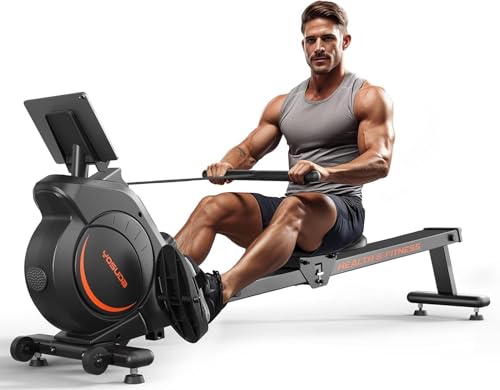
YOSUDA Rowing Machine Review Summary
The YOSUDA Rowing Machine is aimed at home users who want low-impact, full-body cardio without the noise associated with many louder resistance systems.
The manufacturer says each stroke can engage more than 85% of the body’s muscles, while the 16 magnetic resistance levels provide room to progress.
That combination makes it a sensible choice for beginners, general fitness users, and athletes adding rowing to a wider routine.
It is especially appealing for apartments or shared homes because the listing emphasizes stable magnetic resistance and smooth-gliding PU rollers.
The three-wheel seat design and wider track are intended to improve stability, while the monitor and Bluetooth/app support add structure to workouts.
Buy it if quiet operation, progressive resistance, and compact storage matter more than advanced performance data or a large commercial frame.
Review Scorecard
| Category | Editorial score | Buyer-focused rationale |
|---|---|---|
| Full-body training | 9/10 | Rowing targets the arms, legs, core, and back in one low-impact movement. |
| Resistance progression | 8/10 | Sixteen magnetic levels suit a broad range of training stages. |
| Stability | 8/10 | The wider track and integrated three-wheel seat are reassuring design choices. |
| Quiet home use | 9/10 | Magnetic resistance and PU rollers are designed for smooth, low-noise operation. |
| Space efficiency | 8/10 | The listed footprint is 2.9 square feet, with a 59-inch overall length. |
| Workout feedback | 7/10 | The display covers core metrics and Bluetooth/app support expands the system. |
| Setup and support | 8/10 | The listing estimates about 25 minutes for unpacking and installation and includes 24/7 support plus a one-year warranty. |
Key Features and Specifications of YOSUDA Rowing Machine
The YOSUDA Rowing Machine uses magnetic resistance rather than a water tank or air flywheel.
That matters for buyers who want a consistent, jerk-free pull and a quieter machine for indoor training.
The listing describes industrial-grade PU rollers and stable magnetic resistance as part of that experience.
Key facts from the product listing include:
- Sixteen magnetic resistance levels: The range is presented as suitable for beginners through advanced users, allowing gradual increases as fitness improves.
- Low-impact, full-body movement: The manufacturer positions rowing as a way to work the arms, legs, core, and back while being friendly to the knees.
- Wide, stable track: The track and integrated seat design are listed with a load-bearing capacity of up to 350 pounds.
- Three-wheel seat: Three large wheels are fully integrated with the track to support a more stable seat glide.
- Compact dimensions: The machine measures 59 inches long by 19 inches wide by 25 inches high, and the listing gives a 2.9-square-foot footprint.
- Broad height range: The stated user-height range is 4 feet 5 inches to 6 feet 2 inches.
- Monitor and connectivity: The electronic monitor displays time, distance, total count, count, and calories. Bluetooth and app support are also listed for guided programs, performance tracking, and real-time metrics.
- Support coverage: YOSUDA says the product includes 24/7 support and a one-year warranty.
The monitor should be viewed as a practical training aid rather than a replacement for specialized fitness equipment.
Its listed metrics can help you track consistency and session volume, while the app connection may help users who prefer guided plans for fat burning, endurance, or strength improvement.
The dimensions are important before ordering.
Although the footprint is compact, a 59-inch rower still needs clear space for the moving handle and the user’s body.
Measure the area around the machine, not just the floor space occupied when it is standing still.
YOSUDA Rowing Machine Pros and Cons
Pros
- Quiet magnetic operation: A strong fit for apartments, bedrooms, and shared living spaces.
- Progressive training: Sixteen resistance levels make the machine more adaptable than a basic fixed-resistance rower.
- Stable seating design: The wider track and three integrated seat wheels support controlled movement.
- Compact home format: The listed 2.9-square-foot footprint is useful where floor space is limited.
- Useful connectivity: Bluetooth, app support, and a metric display can make regular training easier to organize.
- Low-impact exercise: Rowing offers a full-body cardio option with less knee impact than many high-impact routines.
- Clear support promise: A one-year warranty and 24/7 support add reassurance for home buyers.
Cons
- Limited evidence for advanced performance needs: The available listing does not provide detailed flywheel, rail, handle, or power-output specifications.
- Basic monitor metrics: Time, distance, counts, calories, and total count are useful, but serious rowers may want deeper training data.
- Space still matters: Compact does not mean tiny; the 59-inch length requires a deliberate setup area.
- No hands-on testing is available: This assessment is based on the supplied product listing, so real-world noise, app quality, and long-term durability should be confirmed by current buyer information.
Who Should Buy YOSUDA Rowing Machine?
The best match is a beginner or intermediate home exerciser who wants one machine for conditioning, calorie-burning workouts, and general strength endurance.
The low-impact motion and adjustable resistance make it approachable, while the upper resistance levels leave room to build capacity.
It also suits people who prefer structured app-supported sessions instead of designing every workout from scratch.
Apartment residents and noise-conscious households are another strong audience.
Magnetic resistance and PU rollers are specifically presented as quiet, smooth choices, so the machine is designed around minimizing disruption.
The compact footprint may also work well in a home office, spare room, or corner of a larger living area.
Consider skipping it if you need a commercial-grade rower for daily high-volume training, highly detailed rowing analytics, or a machine selected around a specific unlisted performance specification.
Taller users should also compare their fit carefully against the stated 6-foot-2-inch upper limit, and every buyer should confirm that the full rowing motion fits their available space.
How YOSUDA Rowing Machine Fits Home Training
Magnetic resistance versus workout flexibility
The 16-level resistance range is the machine’s central training advantage.
Beginners can start gently, while experienced users can increase challenge without replacing the equipment.
Because the product is marketed for both endurance and strength improvement, it can support steady sessions as well as more varied interval-style routines.
Stability during the rowing stroke
Rowing feels best when the seat tracks predictably and the frame does not make the user feel unsettled.
YOSUDA emphasizes a wider track, three integrated seat wheels, and capacity up to 350 pounds.
Those are meaningful design considerations for buyers who prioritize confidence and controlled movement, though they are still listing specifications rather than independent test results.
App support and the habit factor
Connectivity is most valuable when it helps you train consistently.
The listed Bluetooth and app features are intended to provide guided programs, real-time metrics, and performance tracking.
Combined with the monitor’s time, distance, count, total count, and calorie readouts, that gives users several ways to make progress visible without requiring a separate training device.
Alternatives to YOSUDA Rowing Machine
If you are comparing home rowers, consider these Amazon-searchable alternatives:
- Concept2 RowErg for buyers prioritizing an established performance-rowing platform and extensive training ecosystem.
- Sunny Health & Fitness magnetic rowing machine for shoppers comparing other compact magnetic home rowers.
- MERACH rowing machine for buyers interested in app-connected home fitness equipment.
- Hydrow rowing machine for shoppers seeking a more premium connected-rowing experience.
These alternatives represent different priorities, from performance-focused training to broader connected-fitness ecosystems.
Compare dimensions, resistance type, connectivity, warranty terms, and the level of workout data before choosing.
Is YOSUDA Rowing Machine Worth It?
So, is YOSUDA Rowing Machine worth it?
Based on the supplied listing, it is a well-targeted option for home users who want quiet magnetic resistance, adjustable challenge, stable seating, and a compact footprint.
Its strongest case is convenience: one low-impact machine, 16 resistance levels, basic workout tracking, and app support in a format intended for everyday indoor use.
The main caveat is that the available evidence is strongest on features and intended use, not independent durability or advanced rowing performance.
If you need deep analytics or commercial-level training hardware, compare more specialized alternatives.
For beginners, apartment users, and general fitness buyers, however, the YOSUDA Rowing Machine pros and cons balance is favorable: choose it when quiet full-body training and progressive home workouts are your priorities, after confirming fit and floor space.