A reliable running foot pod for treadmill workouts can improve distance, pace, cadence, and step tracking when GPS is unavailable or inaccurate indoors.
We compared dedicated treadmill sensors, smart insoles, pedometers, and compatible running accessories to help you choose the right balance of accuracy, features, setup, and price.
Best 10 Running Foot Pod for Treadmill Picks for 2026
Best COROS-Compatible Pick

- Foot- or waistband-mounted accelerometer
- Tracks indoor pace and distance
- Up to 28 hours of battery life
Best For: COROS watch owners training indoors
Best Simple Step Counter

- No app or Bluetooth setup
- 3D tri-axis step sensing
- USB rechargeable battery
Best For: Basic treadmill walking and step tracking
Best Smart Treadmill Upgrade

- Broadcasts speed, incline, and cadence
- Bluetooth and ANT+ connectivity
- Works with Zwift and Kinomap
Best For: Connecting a non-smart treadmill to apps
Best Battery-Saving Pedometer
- No app or Bluetooth required
- 10-step error-prevention feature
- Battery lasts up to one year
Best For: Simple, low-maintenance step tracking
Best Form-Tracking Pick
- 32-sensor system analyzes running form
- App provides coaching and workout metrics
- Compatible with major fitness platforms
Best For: Runners who want detailed technique feedback
Best Legacy Nike Tracking Option

- Tracks time, distance, and pace
- Works with compatible Nike+ shoes
- Supports select Apple devices and Nike+ features
Best For: Existing Nike+ users with compatible gear
Best for Comfort

- Tracks steps and miles without an app
- Uses a long-lasting battery
- Compact and easy to carry
Best For: Users who want basic, no-connection activity tracking
Classic Nike Tracking

- Tracks pace, distance, time, and calories
- Compact sensor for supported older Apple devices
- Limited to legacy Nike + iPod compatibility
Best For: Runners with compatible older iPhones or iPod touch models
Pressure-Based Gait Tracking
Intelligent Insole Pressure Sensor

- Tracks steps, calories, and gait metrics
- Thin 0.45 mm pressure-sensing mat
- Designed for customizable insole integration
Best For: Wearable developers and athletes analyzing treadmill gait
Custom Smart Insole Sensing
Intelligent Pressure Sensor Smart Insole
- Monitors steps, calories, and running form
- Tracks cadence, touchdown time, and knee load
- Designed for customizable wearable integration
Best For: Custom smart-insole and gait-monitoring projects
Best COROS-Compatible Pick – POD 2 Treadmill Sensor
For runners looking for a running foot pod for treadmill use, the COROS POD 2 is designed to measure movement directly from the foot or body. Paired with a compatible COROS watch, it provides responsive pace data and indoor distance tracking without relying on GPS.
Best For: COROS watch owners who want responsive pace and treadmill-distance data.
Pros:
- Uses foot movement and an accelerometer for more responsive instant pace.
- Designed to calculate indoor distance on treadmills and indoor tracks.
- Can clip to a shoe or waistband and includes both clip options.
- Offers up to 28 hours of battery life.
Cons:
- Compatible with COROS watches only, except the COROS PACE 1.
- Requires a COROS watch for its displayed training data.
The POD 2 is the most directly suited option here for runners already using the COROS ecosystem. Its compatibility limitation is significant, but within that ecosystem it focuses on pace responsiveness and indoor-distance measurement.
Best Simple Step Counter – 3D USB Pedometer
This compact 3D pedometer is a straightforward alternative for anyone comparing options for a running foot pod for treadmill workouts. It counts steps without Bluetooth, an app, or smartphone setup, making it better suited to basic movement tracking than detailed run metrics.
Best For: Walkers and casual treadmill users who want simple step counting.
Pros:
- Uses a 3D tri-axis sensor and begins counting after 10 detected steps.
- Requires no Bluetooth, app, or smartphone connection.
- Can clip to clothing, shoes, a pocket, or a lanyard.
- USB rechargeable design can last up to three months per charge.
Cons:
- Tracks steps rather than treadmill pace, distance, or cadence.
- Does not connect to running watches or fitness apps.
- Its basic display and controls offer limited workout data.
This is an easy, low-maintenance choice when step totals are all you need. Runners seeking precise treadmill distance or live pace should consider a connected sensor instead.
Best Smart Treadmill Upgrade – Runn Retrofit Sensor
Runn... Retrofit Smart Treadmill Sensor - Make Your Treadmill a Smart Treadmill!
Check Price On AmazonThe Runn Retrofit Smart Treadmill Sensor is a strong choice for users who want more than a traditional running foot pod for treadmill training. It attaches to a compatible treadmill and broadcasts speed, incline, and cadence over Bluetooth or ANT+ to supported apps and devices.
Best For: Indoor runners who want to connect a non-smart treadmill to training apps.
Pros:
- Broadcasts treadmill speed, incline, and running cadence.
- Supports both Bluetooth and ANT+ connectivity.
- Works with Zwift, Kinomap, and many other applications.
- Can connect Apple Watch Series 2 or newer heart rate to an app through the heartbeatz connect app.
Cons:
- Mounts to the treadmill rather than attaching directly to a shoe.
- Requires installation with mounting hardware and deck tape.
- Battery life is up to 15 hours between charges.
Runn is better viewed as a treadmill sensor and connectivity upgrade than a conventional foot pod. Its broader metric support makes it the more capable option for app-based indoor training, provided you are comfortable mounting and configuring it.
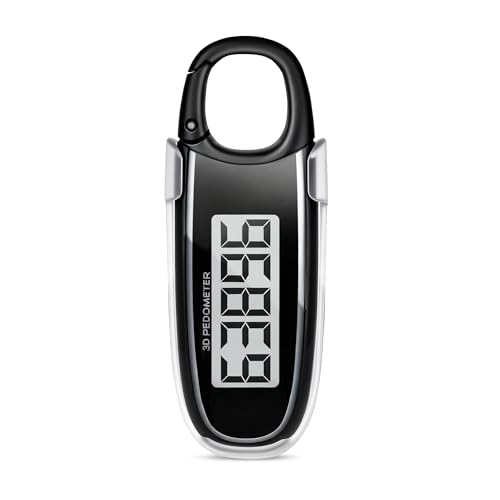
Best Battery-Saving Pedometer – 3D Clip-On Step Counter
For shoppers considering a running foot pod for treadmill use but needing only basic step totals, this clip-on 3D pedometer keeps setup simple. It uses a tri-axis motion sensor, requires no app or Bluetooth, and includes a display for checking progress during everyday activity.
Best For: Users who want uncomplicated, long-term step tracking on a waistband or bag.
Pros:
- Counts movement in multiple directions with a 3D tri-axis sensor.
- Starts counting after 10 continuous steps to reduce accidental counts.
- Includes a detachable clip and built-in carabiner.
- The included battery can typically last up to one year.
Cons:
- Measures steps, not running pace, treadmill distance, or cadence.
- Does not provide Bluetooth or smartphone connectivity.
- Irregular walking, mobility aids, or vehicle travel may affect accuracy.
This pedometer is practical for simple, independent tracking and minimizes charging needs. It is not a substitute for a connected treadmill sensor when workout metrics or app integration matter.
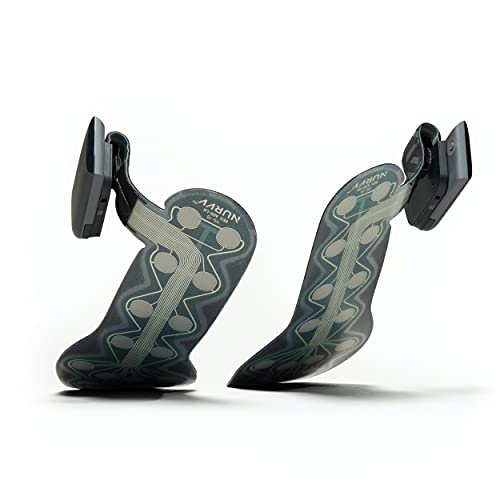
Best Form-Tracking Pick – NURVV Run Smart Insoles
For runners seeking a running foot pod for treadmill use, the NURVV Run Smart Insoles provide a more detailed alternative to basic step tracking. Their connected insoles use 32 sensors to analyze running form, while the app tracks pace, distance, time, calories, footstrike, cadence, and other metrics for indoor or outdoor workouts.
Best For: Runners who want real-time coaching and detailed form feedback during treadmill or outdoor training.
Pros:
- Measures pronation, footstrike, step length, balance, and cadence.
- Offers real-time coaching through the NURVV app.
- Works with iOS, Android, Garmin, Apple Watch, heart-rate monitors, Strava, and Apple Health.
- Includes built-in GPS for distance tracking.
Cons:
- Requires wearing connected insoles rather than using a simple clip-on sensor.
- Uses two included lithium-ion batteries and requires the NURVV app for its broader features.
This is the strongest option here for runners focused on technique and performance data. It is more involved than a basic pedometer, but its coaching and form metrics make it better suited to structured treadmill training.
Best Legacy Nike Tracking Option – Nike+ Standalone Sensor
The Nike+ Standalone Sensor is a compact running foot pod for treadmill and general run tracking when used with compatible Nike+ shoes and devices. It records time, distance, pace, and related run data, while supported Nike+ features include challenges, run mapping, and social connections.
Best For: Runners who already use compatible Nike+ shoes, iPod devices, or an iPhone and want straightforward run tracking.
Pros:
- Records time, distance, and pace.
- Designed to connect with most Nike+ compatible shoes.
- Supports compatible iPod touch, iPod nano, and iPhone devices.
- Enables Nike+ challenges, run mapping, and social connections.
Cons:
- Compatibility is centered on Nike+ compatible shoes and listed Apple devices.
- The supplied details do not confirm current software-update support.
This sensor makes the most sense for users already invested in the Nike+ ecosystem. Before buying, confirm that your shoes and device are compatible, especially if you want to use it for treadmill workouts.
Best for Comfort – TrenHivSto Clip-On Pedometer
The TrenHivSto clip-on pedometer is a basic, low-maintenance choice for anyone considering a running foot pod for treadmill use but only needs steps and miles. It has no Bluetooth, smartphone connection, charging routine, or notifications, making it easy to use for straightforward activity tracking.
Best For: Walkers, casual runners, seniors, and families who want simple step and mile tracking without an app.
Pros:
- Compact 1.3-ounce design can be clipped on or carried in a pocket.
- Requires no Bluetooth, smartphone, app, or charging.
- Battery is rated for over 12 months of continuous use.
- Automatically stops counting when inactive and retains data.
Cons:
- Does not provide pace, form, coaching, GPS, or connected workout metrics.
- For best accuracy, it must be secured snugly at the waist.
- May be inaccurate with light steps, irregular movement, vibration, biking, or vehicle travel.
This is the simplest and least demanding option, but it is not a full running-performance sensor. It can suit treadmill users who mainly want step and mile totals and prefer a standalone display over connected features.
Classic Nike Tracking – Nike+ Stand Alone Sensor Kit
The Nike+ Stand Alone Sensor Kit is a legacy option for runners looking for a running foot pod for treadmill use, provided they have a compatible older iPhone, iPod touch, or computer setup. It tracks pace, distance, elapsed time, and calories burned through Nike + iPod.
Best For: Runners using supported older Apple devices who want basic running metrics from a Nike+ sensor.
Pros:
- Measures pace, distance, elapsed time, and calories burned.
- Compact, lightweight sensor weighing 22.68 g in the package.
- Supports Nike + iPod tracking on compatible older iPhones and iPod touch models.
Cons:
- Not compatible with iPhone 6 or newer devices.
- Not supported by devices using iOS 9.0 or higher.
- Requires a compatible Nike + iPod setup and occasional sensor-link troubleshooting.
This sensor can suit a legacy Apple setup, but its compatibility limitations make it a poor fit for most current smartphones. Verify your device and operating system before buying.
Pressure-Based Gait Tracking – Intelligent Insole Pressure Sensor
This intelligent insole pressure sensor is a development-oriented running foot pod for treadmill and indoor training projects. Its thin pressure-sensing mat is designed to capture steps, calories, and gait information while fitting into an intelligent insole.
Best For: Developers, athletes, and wearable-project builders who need pressure-based foot and gait data.
Pros:
- Supports step and calorie tracking.
- Captures gait metrics such as posture, landing method, cadence, and knee load index.
- Thin 0.45 mm profile responds to 400 g of pressure.
- Weather-protected design is intended for indoor and outdoor activity.
Cons:
- Listed as a sensor component rather than a complete consumer tracking system.
- Requires integration into an intelligent insole or compatible wearable application.
- Stable operation is specified at DC 3.3V, so setup knowledge may be needed.
For treadmill runners building or customizing a connected insole, this sensor offers useful pressure and gait capabilities. It is less suitable if you want a ready-to-use foot pod with a standalone app.
Custom Smart Insole Sensing – Intelligent Pressure Sensor Smart Insole
The Intelligent Pressure Sensor Smart Insole is a customizable running foot pod for treadmill and other fitness applications. It is designed to integrate into wearable products and monitor steps, calories, posture, cadence, touchdown time, landing method, and knee load index.
Best For: Fitness technology projects and runners seeking detailed pressure-based form monitoring through a customized wearable.
Pros:
- Supports step counting and calorie tracking.
- Provides real-time gait information, including cadence and touchdown time.
- Customizable for different wearable products and applications.
- Designed for high sensitivity and prolonged use.
Cons:
- Requires integration into a compatible wearable product.
- Customization may involve additional development work.
- Product details do not indicate a complete ready-to-run treadmill tracking system.
This sensor is a flexible foundation for a smart insole or gait-monitoring project. Choose it when customization matters more than plug-and-play convenience.
How We Picked the Best Running Foot Pod for Treadmill
We organized these 10 options around the needs of indoor runners and walkers. Dedicated sensors were evaluated for treadmill distance tracking, compatibility, calibration potential, and usefulness during structured workouts. Smart insoles were considered for gait, pressure, cadence, and coaching data, while basic pedometers were included for shoppers who mainly need steps or approximate distance.
We also considered practical factors such as attachment method, charging, app or device dependence, visibility, durability, and how much setup each product requires. Because treadmill consoles, watches, and phones do not all use the same connection standards, compatibility should be confirmed before purchase.
Quick Comparison
| Type | Best For | Typical Strength | Possible Limitation |
|---|---|---|---|
| Dedicated running sensor | Runners tracking pace and distance | More focused indoor metrics | May require calibration or a compatible watch |
| Treadmill retrofit sensor | Adding smart features to a treadmill | Can transmit equipment data | Installation and compatibility vary |
| Smart insole | Gait, pressure, and coaching insights | Detailed foot-strike information | Higher cost and more setup |
| Basic pedometer | Walking and simple step counting | Simple, portable, and affordable | Usually less precise for running pace |
Key Buying Factors for a Running Foot Pod for Treadmill Workouts
Accuracy and Calibration
Look for a sensor that can be calibrated to your stride or matched to a known treadmill distance. A pod that records cadence and pace consistently may be more useful than one with many features but poor indoor accuracy.
Compatibility
Check whether the device connects by Bluetooth, ANT+, a proprietary app, or a specific running watch. Some products track independently, while others require a phone, smartwatch, or treadmill receiver to display results.
Metrics and Training Value
Basic models may count steps and estimate miles. Advanced sensors can provide pace, distance, cadence, stride, gait, pressure distribution, calories, or coaching feedback. Choose metrics that support your actual training goals.
Fit, Battery, and Maintenance
Clip-on devices should stay secure without interfering with your stride. Insoles need the correct shoe size and should remain comfortable during longer sessions. Consider charging frequency, water resistance, replaceable batteries, and app support before buying.
Who Should Buy Which Running Foot Pod for Treadmill?
For Serious Indoor Runners
Choose a dedicated running sensor such as the COROS accessory or a compatible smart treadmill sensor if consistent pace and distance are priorities.
For Runners Interested in Gait or Injury Prevention
Smart insoles are the better fit when you want pressure, stride, gait, or coaching information in addition to basic distance tracking.
For Casual Walkers and Simple Tracking
A rechargeable or clip-on 3D pedometer is usually sufficient for steps and approximate miles without the complexity of a connected training system.
For Owners of Older Nike-Compatible Equipment
Nike+ sensors may be useful only if your existing shoes, receiver, or app ecosystem supports them. Confirm compatibility carefully, since older accessories can have limited current-device support.