The best adjustable calf stretchers make it easier to control your stretch intensity, improve ankle mobility, and build a consistent warm-up or recovery routine. This roundup compares wooden and plastic slant boards with different angle settings, weight capacities, and portability features.
Whether you need a stable board for home workouts, a compact option for travel, or a versatile platform for squats and physical therapy exercises, the right choice should match your mobility level, available space, and preferred construction.
Best 10 Adjustable Calf Stretchers Picks for 2026
Best Overall

- Five adjustable angles from 15° to 35°
- Hardwood plywood with full non-slip coverage
- Side handle and broad stretching versatility
Best For: Stable, all-purpose calf stretching and mobility work
Best for High Weight Capacity
500 lb Wooden Calf Stretch Board
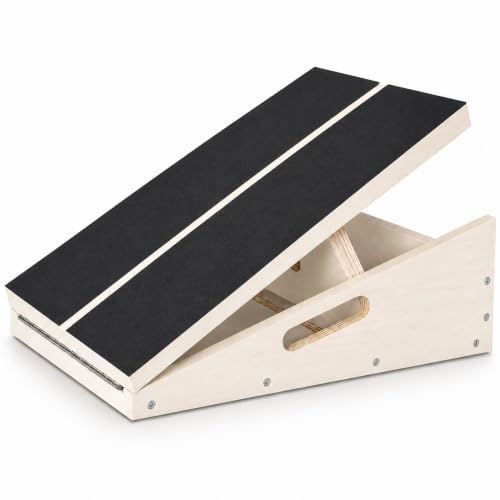
- Supports up to 500 pounds
- Five angles from 15° to 35°
- Includes exercise guide and three-year warranty
Best For: High-capacity stretching, squats, and mobility work
Best Portable Option

- Lightweight 3.7-pound ABS construction
- Five adjustable incline levels
- Textured surface and heel lip for stability
Best For: Travel, office use, and compact home setups
Best Foldable Design
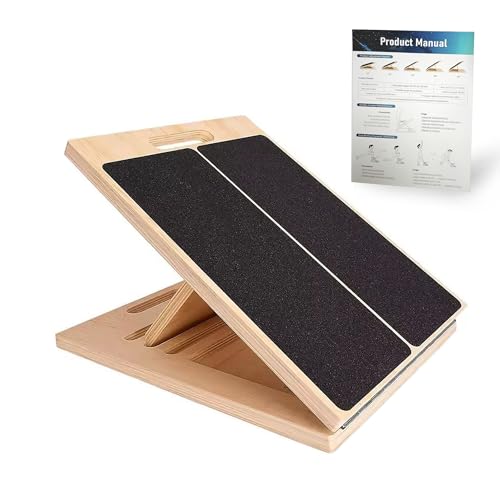
- Folds flat for compact storage
- Five angles from 20° to 45°
- 350-pound capacity with non-slip surface
Best For: Home users needing easy storage and progression
Best Adjustable Calf Stretchers with Bands

- Five adjustable angles from 23° to 45°
- Includes two physical therapy resistance bands
- Non-slip, lightweight design for home or travel
Best For: Portable stretching and resistance-training routines
Best Heavy-Duty Adjustable Calf Stretchers

- Steel frame with a stated 660-pound capacity
- Four adjustable angles from 15° to 40°
- Detachable padded tube supports incline squats
Best For: Stable home-gym stretching and incline training
Best Simple Adjustable Calf Stretchers

- Five angles from 23° to 45°
- Folds and weighs 4.6 pounds for portability
- Works for calf, ankle, heel, and leg mobility
Best For: Simple home, office, or gym stretching
Best Adjustable Range
Five-Position Wooden Calf Stretch Board

- Five incline settings from 23° to 45°
- Supports up to 460 pounds
- Textured surface and EVA base for traction
Best For: Progressive calf, ankle, and lower-body mobility routines
Best for Portability
Folding Wooden Calf Stretch Board

- Folds with a carry handle and magnetic closure
- Four angles from 20° to 40°
- Designed for loads up to 500 pounds
Best For: Travel, office storage, and compact home workouts
Best for Rehab Routines
Portable Adjustable Slant Board

- Four positions from 30° to 45°
- Lightweight wooden construction
- Suitable for stretching and physical therapy
Best For: General mobility, Pilates, and rehabilitation exercises
Best Overall – StrongTek Wooden Slant Board
The StrongTek Wooden Slant Board is a well-rounded choice for shoppers seeking adjustable calf stretchers for warm-ups, flexibility work, and lower-leg recovery. Its five incline settings, wooden construction, side handle, and full-coverage non-slip surface make it suitable for home workouts, rehabilitation routines, and portable use.
Best For: Users who want a sturdy, versatile wooden board for calf stretching, ankle mobility, squats, and recovery exercises.
Pros:
- Five adjustable angles from 15° to 35° accommodate different flexibility levels.
- Full-coverage anti-slip treads help provide secure footing.
- High-quality hardwood plywood construction with a side carry handle.
- Supports stretching related to plantar fasciitis, Achilles tendon issues, shin splints, and calf strains.
Cons:
- At 9 pounds, it is heavier than many compact plastic alternatives.
- The fixed wooden design does not fold flat for storage.
This is a practical all-purpose pick if stability and durable construction matter more than minimum weight. The five settings also make it easier to start gently and increase the incline as mobility improves.
Best for High Weight Capacity – 500 lb Wooden Calf Stretch Board
This wooden calf stretch board is a strong option among adjustable calf stretchers for users who prioritize a high weight rating and a stable platform. It offers five angle settings, a textured standing surface, a slip-resistant base, and enough versatility for stretching, calf raises, squats, and ankle mobility drills.
Best For: Users who want a sturdy wooden board rated for up to 500 pounds and suitable for home or gym training.
Pros:
- 500-pound capacity provides substantial support for a wide range of users.
- Five settings from 15° to 35° allow gradual progression.
- Textured top and slip-resistant base help improve stability.
- Includes an exercise guide, side carry handles, and a three-year manufacturer warranty.
Cons:
- Its wooden build weighs about 3.85 kg, so it is less convenient than a lightweight plastic board.
- The board is not described as foldable.
Choose this model when load capacity and a secure stance are top priorities. The exercise guide and broad exercise compatibility also make it useful for beginners building a consistent mobility routine.
Best Portable Option – StrongTek ABS Slant Board
The StrongTek ABS Slant Board stands out among adjustable calf stretchers for its compact, lightweight design. Made from durable ABS plastic, it weighs 3.7 pounds and provides five incline levels, a textured surface, and a heel lip for use during calf stretches, squats, strengthening exercises, and physical therapy routines.
Best For: Travelers, office users, and anyone who needs a lightweight calf stretcher that is easy to carry and clean.
Pros:
- Compact 12-by-10.6-inch footprint and 3.7-pound weight make it highly portable.
- Five adjustable incline levels support customized stretching.
- Textured anti-slip surface and heel support help keep feet positioned.
- ABS construction supports up to 300 pounds and wipes clean with a damp cloth.
Cons:
- Its 300-pound capacity is lower than the 500-pound wooden option.
- The smaller platform may provide less room than full-size wooden boards.
This is the most convenient pick for users who move their equipment frequently or have limited storage. It trades some platform size and weight capacity for portability and easy maintenance.
Best Foldable Design – Wooden 5-Angle Calf Stretcher
This foldable wooden board is a convenient choice among adjustable calf stretchers for users who need straightforward storage. It offers five incline levels from 20° to 45°, a non-slip surface, a 350-pound capacity, and a ready-to-use design for stretching, Pilates, yoga, squats, and rehabilitation exercises.
Best For: Users who want a wooden calf stretcher that folds flat for storage under a bed, beside a desk, or in a gym bag.
Pros:
- Folds flat for compact storage and transport.
- Five angles from 20° to 45° provide a broad range of challenge levels.
- Non-slip surface and 350-pound capacity support stable stretching.
- Arrives fully assembled and includes an instruction guide.
Cons:
- Its lowest 20° setting may be less gentle than boards starting at 15°.
- The listed dimensions and 5-pound weight may be less compact than a small plastic model.
Pick this model if storage convenience is a deciding factor but you still prefer a wooden platform. Its higher maximum angle is also useful for users who want room to progress their stretching routine.
Best Adjustable Calf Stretchers with Bands – Portable 5-Angle Wooden Board
If you want adjustable calf stretchers that also support resistance work, this wooden slant board combines five incline settings with two physical therapy bands. Its non-slip surfaces and portable design make it practical for home workouts, rehabilitation routines, or taking to the office or gym.
Best For: Beginners and experienced users who want a portable calf board with adjustable angles and included resistance bands.
Pros:
- Five angles from 23° to 45° allow gradual progression.
- Includes yellow and red resistance bands with different tension levels.
- Non-slip EVA base and PVC sandpaper surface help limit movement during use.
- Lightweight 4.5-pound wooden construction is easy to carry.
Cons:
- Wood construction may not suit shoppers who specifically prefer steel equipment.
- The listed product details include both a 460-pound support claim and a 300-pound maximum-weight recommendation, so buyers should follow the more conservative rating.
This is a versatile choice when you want more than a basic incline board. The five settings, resistance bands, exercise guide, and compact build give it strong appeal for stretching and mobility routines.
Best Heavy-Duty Adjustable Calf Stretchers – PROIRON Steel Slant Board
Among adjustable calf stretchers, the PROIRON stands out for its steel construction and high stated load capacity. Four incline positions, padded foot support, and rubber feet make it suited to users who want a sturdy platform for calf stretching, ankle mobility work, and incline squats.
Best For: Users prioritizing a heavy-duty steel frame, padded contact point, and dual-use stretching and incline-squat functionality.
Pros:
- Steel construction and a stated capacity of up to 660 pounds provide a substantial design.
- Four adjustable angles from 15° to 40° accommodate gentler and more demanding stretches.
- 8mm NBR foam padding helps cushion the heel during prolonged stretching.
- Detachable padded tube allows use as an incline bench for squats.
Cons:
- At 5.78 kg, it is considerably heavier than the listed wooden alternatives.
- It offers four angle settings rather than five.
- The steel build may be less convenient for frequent transport.
This is the strongest fit for buyers who value stability and durability over portability. Its detachable tube also gives it more exercise versatility than a single-purpose slant board.
Best Simple Adjustable Calf Stretchers – Foldable 5-Angle Slant Board
For shoppers seeking straightforward adjustable calf stretchers, this wooden slant board offers five incline levels without requiring setup. It supports one or both feet, folds for transport, and can be used for calf, ankle, heel, glute, and general leg mobility routines.
Best For: Beginners and experienced exercisers who want a simple, portable wooden board for stretching, yoga, and mobility work.
Pros:
- Five angles from 23° to 45° provide adjustable stretch intensity.
- Foldable, lightweight 4.6-pound design is convenient for home or gym use.
- Supports one- or two-foot stretching and several lower-body mobility exercises.
- Includes a workout poster and instructions.
Cons:
- No resistance bands are included.
- The listing specifies no warranty.
- The stated maximum weight recommendation is 300 pounds despite a 460-pound capacity highlight.
This option keeps the setup simple while still offering a useful range of angles. It is a practical pick for users who want portability and basic stretching functionality rather than extra accessories.
Best Adjustable Range – Five-Position Wooden Calf Stretch Board
If you want adjustable calf stretchers that can accommodate different flexibility levels, this wooden slant board offers five incline settings from 23° to 45°. Its textured PVC surface, non-slip EVA base, and 460-pound capacity make it a practical option for stretching, warm-ups, squats, and mobility work.
Best For: Users who want the widest range of angle adjustments for progressive calf, ankle, and lower-body routines.
Pros:
- Five settings—23°, 30°, 35°, 40°, and 45°—support gradual progression.
- 11-ply poplar construction supports up to 460 pounds.
- Textured PVC footing and an EVA base help provide traction.
- Arrives assembled and includes a training poster and instruction guide.
Cons:
- Wood construction may be less compact than a fully folding design.
- The supplied dimensions are relatively substantial for carrying in smaller bags.
With its five angle choices and portable 4.5-pound build, this is a versatile pick for home, gym, office, or physiotherapy use. The squat and mobility applications add value beyond basic calf stretching.
Best for Portability – Folding Wooden Calf Stretch Board
Among adjustable calf stretchers, this folding wooden wedge stands out for convenient transport and storage. It offers four incline positions from 20° to 40°, a carry handle, magnetic closure, non-slip foot surface, and a stated 500-pound capacity for home, office, and gym routines.
Best For: People who need an adjustable calf stretcher that folds away easily and travels between locations.
Pros:
- Folds to a compact profile and includes an integrated carry handle.
- Four positions—20°, 25°, 30°, and 40°—allow changes in stretch intensity.
- 12-layer wood construction is designed to support up to 500 pounds.
- Non-slip foot surface and bottom grip pads support a planted setup.
Cons:
- It provides four angle settings rather than five.
- The product details list conflicting weight information, so buyers should verify the current specification.
The folding frame, magnetic closure, and carry handle make this the most storage-friendly option in the group. It is well suited to users who want one board for stretching, warm-ups, recovery, and mobility breaks throughout the day.
Best for Rehab Routines – Portable Adjustable Slant Board
This portable slant board is a straightforward choice among adjustable calf stretchers for stretching, squats, Pilates, and physical therapy routines. Its four settings range from 30° to 45°, while the lightweight wooden design can be used at home, in an office, gym, or physiotherapy clinic.
Best For: Beginners, athletes, and adults seeking a simple adjustable board for mobility or rehabilitation-focused exercise.
Pros:
- Four adjustable positions—30°, 35°, 40°, and 45°—support different routine intensities.
- Lightweight design weighs about 4.5 to 5 pounds for easier transport.
- Suitable for stretching, weight-bearing exercise, Pilates, squats, and physical therapy.
- Designed for use across a broad range of fitness levels.
Cons:
- It lacks the lower 20° to 25° settings offered by some alternatives.
- The supplied notes do not specify a maximum load capacity.
- No non-slip surface or base material is identified in the product details.
Its uncomplicated four-position design and portable size make it a practical option for general mobility and rehabilitation exercises. Buyers who prioritize a clearly stated load rating or detailed traction features may prefer another board.
How We Picked the Best Adjustable Calf Stretchers
We focused on the features that most affect real-world use: adjustable incline range, platform size, surface traction, construction, portability, and stated weight capacity. We also considered whether each board is useful beyond basic calf stretching, including ankle-mobility drills, squats, Pilates, warmups, and rehabilitation exercises.
Weight ratings are manufacturer claims and should not be treated as a substitute for careful setup. A secure, level floor and a board that remains stable under your body weight matter more than a high capacity alone.
Quick Comparison
| Feature | What to look for | Why it matters |
|---|---|---|
| Adjustment range | Multiple fixed angles, often about 20° to 50° | Lets beginners start gently and progress gradually |
| Construction | Wood, ABS plastic, or steel | Determines stability, durability, and portability |
| Traction | Non-slip surface and secure floor contact | Helps reduce foot or board movement |
| Capacity | Approximately 350 to 660 pounds in this selection | Provides a useful safety margin when used correctly |
| Portability | Handles, folding designs, or lighter materials | Makes storage and travel easier |
Key Buying Factors for Adjustable Calf Stretchers
Angle Control
More positions give you better control over intensity. A lower angle is generally easier for starting mobility work, while steeper settings can provide a deeper stretch. Choose a board with clearly supported positions rather than relying on improvised elevation.
Stability and Traction
Look for a textured foot surface, rubberized feet, or another design that limits sliding. Side handles can make some wooden boards easier to carry, but they do not replace a stable base. Use the stretcher on a hard, level surface and avoid sudden bouncing.
Size and Comfort
Check the platform dimensions against your shoe size and stance. A wider, longer surface can feel more secure, especially during squats or balance-focused drills. If the edge presses into your feet, even a well-built board may be uncomfortable for longer sessions.
Materials and Weight Capacity
Wooden boards often feel solid and attractive for home use, while ABS plastic models may be lighter and easier to transport. Steel designs can offer substantial support but may add weight. Treat listed capacity as a guideline and inspect hinges, adjustment points, and surfaces regularly.
Who Should Buy Which Adjustable Calf Stretchers?
Choose a wooden board if you prioritize a stable, sturdy feel for home stretching, squats, or physical therapy exercises. These models are often best for users who do not need to carry the board frequently.
Choose a plastic or foldable model if storage and portability are important. A lighter board is convenient for office use, travel, or moving between rooms, provided its base and surface remain secure.
Choose a steel model if maximum sturdiness and a high stated capacity are priorities. It may be the better fit for heavier users or demanding strength routines, but confirm that the added weight and size suit your space.
Choose the widest angle selection if you are progressing from gentle mobility work to deeper stretches. Regardless of the model, increase the angle gradually, stop if you feel sharp pain, and consult a qualified clinician when recovering from an injury.