The best pull-up bars for home workouts make it easier to build back, arm, shoulder, and core strength without a full gym setup. The right choice depends on your doorway or wall construction, available floor space, preferred exercises, and weight capacity.
We selected 10 options spanning no-drill doorway bars, multi-grip models, joist-mounted designs, and full power towers so you can match your equipment to your training goals and home layout.
Best 10 Pull Up Bars for Home Workouts Picks for 2026
Best Doorway Value

- 440-pound stated capacity with thickened steel
- Silicone door-frame protection
- Supports pull-ups, dips, push-ups, and crunches
Best For: Removable, versatile doorway workouts
Best Wall-Mounted Option
Multifunctional Dip Station Bar

- Fixed steel station rated to 440 pounds
- Includes pull-up, dip, leg-raise, and boxing exercises
- Designed for solid masonry or tile walls
Best For: Permanent home gyms with suitable solid walls
Best Freestanding Station

- Nine height settings for varied users
- Supports up to 400 pounds
- Adds dips, knee raises, rows, and push-ups
Best For: Adjustable, wall-free family home gyms
Best Space-Saving Doorway Bar

- Foldable design for quick storage
- Fits 21.65- to 36.22-inch doorways
- Includes multiple grips and suspension straps
Best For: Compact, versatile doorway training
Best All-in-One Station
Adjustable Power Tower Dip Station

- 11 adjustable height levels
- Supports pull-ups, dips, and knee raises
- Stable H-shaped base with safety locknuts
Best For: Families and users building a versatile home gym
Best No-Drill Option

- Fits 29.5- to 37-inch door frames
- No-drill installation with dual gear locks
- Rated for up to 440 pounds
Best For: Adults with compatible solid wood door frames
Best Joist-Mounted Design
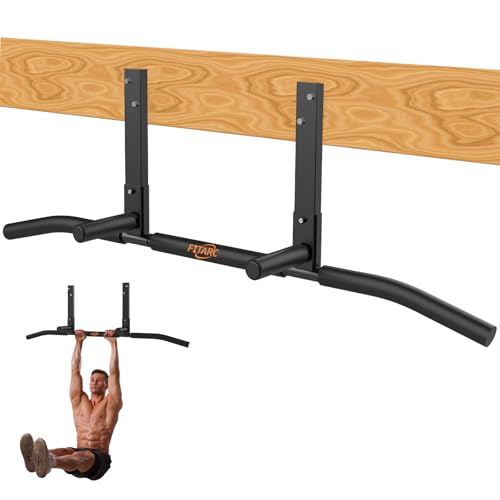
- Heavy-duty steel rated for 440 pounds
- Four padded, anti-slip grip positions
- Designed for wooden beams and garage gyms
Best For: Users with suitable joists or overhead wooden beams
Best Adjustable Set
6-Piece Doorway Pull-Up Bar Set

- Includes bands, handles, and exercise manuals
- Multiple width options for suitable spaces
- Requires solid mounting surfaces and careful measuring
Best For: Users wanting pull-ups plus resistance-band exercises
Best Full-Body Station

- Supports pull-ups, dips, push-ups, and knee raises
- Nine height settings and adjustable armrests
- Freestanding design with an 86-inch height
Best For: Users building a versatile home bodyweight-training station
Best Simple Pick

- Installs without drilling into the doorway
- Padded multi-grip design for varied exercises
- Fits specified 23–31-inch standard doorways
Best For: Users wanting a portable bar for a compatible doorway
Best Doorway Value – Heavy-Duty Ally Peaks Bar
For pull up bars for home workouts, the Ally Peaks doorway model offers a versatile setup without permanent mounting. Its steel construction, multiple grip positions, and support for several bodyweight exercises make it a practical option for standard doorways.
Best For: Home users who want a removable doorway bar for pull-ups, chin-ups, dips, push-ups, and hanging crunches.
Pros:
- Supports up to 440 pounds and uses 1.7mm thickened steel.
- Silicone door-frame protection is designed to reduce marks and improve fit.
- Portable, screw-free design fits standard 24- to 32-inch doorways.
- Multiple functions can replace several pieces of basic home equipment.
Cons:
- Fit depends on the doorway’s width, depth, trim height, and trim thickness.
- It is not a standalone station for users who lack a suitable door frame.
This is a strong all-around pick when you want broad exercise options and easy storage. Measure the doorway carefully and test the bar’s security before each workout.
Best Wall-Mounted Option – Multifunctional Dip Station Bar
Among pull up bars for home workouts, this wall-mounted model is suited to users who want a fixed exercise station. It combines pull-up and chin-up grips with dip, leg-raise, and boxing capabilities, but installation requires a suitable solid wall.
Best For: Home gyms with concrete, solid cement, solid red brick, or solid tile walls.
Pros:
- Heavy-duty steel construction supports up to 440 pounds.
- Offers pull-ups, chin-ups, dips, leg raises, and boxing exercises.
- High-density non-slip grips and four strong steel hooks promote stability.
- Includes concrete anchors for installation.
Cons:
- Requires a drill, hammer, and 12mm bit for concrete installation.
- Not suitable for drywall, hollow brick, honeycomb brick, or sandwich panels.
- Wall mounting is less portable than a doorway or freestanding design.
This bar makes sense when you can dedicate a structurally appropriate wall to a permanent workout station. Confirm the wall type before purchasing, since the product is explicitly not designed for hollow or drywall surfaces.
Best Freestanding Station – RELIFE Adjustable Power Tower
This RELIFE power tower is a useful alternative to doorway pull up bars for home workouts when you want a self-contained station. Its adjustable height, pull-up and dip functions, and compact footprint support a wider range of bodyweight training without wall installation.
Best For: Families or home-gym users who want an adjustable freestanding tower for pull-ups, dips, knee raises, push-ups, and rows.
Pros:
- Freestanding design avoids doorway or wall mounting.
- Nine adjustable heights include a lower setting designed for children.
- Supports up to 400 pounds and includes a safety locknut and four suction cups.
- Armrests have three adjustment levels for different arm lengths.
Cons:
- Its 83-inch height requires adequate ceiling clearance.
- The design has no backrest.
- Assembly requires all screws to be tightened correctly for stability.
The power tower is the most flexible choice here for shared use and varied bodyweight exercises. It needs more floor and vertical space than a doorway bar, but it avoids concerns about door-frame compatibility.
Best Space-Saving Doorway Bar – KAKICLAY Multi-Grip Bar
For pull up bars for home workouts in tight spaces, the KAKICLAY multi-grip bar emphasizes broad doorway compatibility and compact storage. Its foldable design, angled grips, silicone protectors, and included suspension straps add versatility while keeping the setup removable.
Best For: Users who need a foldable doorway bar with multiple grip choices and suspension-strap compatibility.
Pros:
- Fits door widths from 21.65 to 36.22 inches and supports up to 440 pounds.
- Foldable design stores quickly after training.
- Offers angled, shoulder-width, and close-grip options with foam handles.
- Includes suspension straps and silicone door protectors.
Cons:
- Requires careful measurement of doorway width, depth, and trim height.
- Not suitable for hollow plasterboard walls or compromised door frames.
- It is limited by doorway installation rather than being freestanding.
This is a compelling pick for apartments, corners, and other spaces where storage matters. Verify the frame’s condition and dimensions before relying on the stated capacity.
Best All-in-One Station – Adjustable Power Tower Dip Station
If you want pull up bars for home workouts that support more than pull-ups, this adjustable power tower combines upper-body and core exercises in one freestanding unit. Its height range, padded backrest, dip handles, and included resistance bands make it suitable for varied home training.
Best For: Families or home gym users who want a versatile station for pull-ups, dips, push-ups, and knee raises.
Pros:
- Offers 11 height levels from 71.4 to 84.9 inches.
- Supports pull-ups, chin-ups, dips, push-ups, and vertical knee raises.
- Features a 41.73-inch extended H-shaped base, non-slip feet, and safety locknuts.
- Includes a padded backrest and bonus elastic resistance bands.
Cons:
- The freestanding design requires more floor space than a doorway bar.
- Although the listing mentions quick assembly, the detailed instructions estimate 30 to 60 minutes and recommend two people.
With its broad exercise selection and adjustable design, this power tower is a practical choice for a dedicated home workout area. Check the available space and ceiling height before buying.
Best No-Drill Option – Sportneer Doorway Pull-Up Bar
For renters or anyone avoiding permanent installation, this doorway bar is a convenient option among pull up bars for home workouts. It uses a no-drill locking system, but safe use depends on having a compatible solid wood door frame.
Best For: Adults with solid wood door frames measuring 29.5 to 37 inches wide.
Pros:
- Installs without drilling and is designed to leave no traces from installation.
- Supports up to 440 pounds according to the product listing.
- Uses PVC friction mats, four metal fixed points, and a 360-degree dual gear lock.
- Has independently tested structural and environmental safety certifications noted in the listing.
Cons:
- Only fits compatible solid wood door frames within the specified width range.
- Paint or plaster may peel when the bar is removed because of strong adhesion.
- The listing notes that longer use distances may reduce the load capacity.
This is a space-saving choice when your doorway meets the installation requirements. Measure the frame carefully and confirm it is solid wood before using the bar.
Best Joist-Mounted Design – Fitarc Wall Mount Pull-Up Bar
This joist-mounted bar is a strong fit for pull up bars for home workouts when you have a suitable wooden beam, basement, or garage setup. Its compact ceiling-mounted structure provides multiple grip positions while keeping the workout area relatively open.
Best For: Home gym users installing a pull-up station on wooden joists or 8- to 9-foot beams.
Pros:
- Heavy-duty steel construction is rated for up to 440 pounds.
- Supports pull-ups, chin-ups, hanging leg raises, and core training.
- Includes four padded, anti-slip grip positions to help reduce hand fatigue.
- Comes with installation instructions and videos.
Cons:
- Requires an appropriate wooden beam or joist for installation.
- Installation is permanent or semi-permanent compared with a doorway bar.
- The listing provides mounting guidance for 8- to 9-foot beams, so placement should be verified beforehand.
For a garage or basement gym with suitable overhead framing, this bar offers a compact way to add pull-ups and hanging exercises. Confirm the joist and mounting location can accommodate the installation before purchasing.
Best Adjustable Set – 6-Piece Doorway Pull-Up Bar Set
This six-piece option is designed for pull up bars for home workouts when you want more than a bar alone. It includes two resistance bands, two handles, and exercise manuals, with adjustable width models for doorways or suitable hallways. Measure carefully before ordering and verify that your frame or mounting location is solid.
Best For: Home users who want a doorway or hallway bar with added resistance-band training options.
Pros:
- Includes two resistance bands, two handles, and training manuals.
- Available in multiple width ranges, including 27–37 inches and 37–47 inches.
- Padded contact areas are designed to help prevent marks or chipped paint.
- Rated for up to 680 pounds according to the supplied specifications.
Cons:
- The 46–53-inch model is too large for standard doorways and is intended for extra-wide hallways.
- Not suitable for hollow-gap doorframes or hallway installation without solid studs behind the drywall.
- Requires careful measuring and frame-strength testing before use.
This set offers useful versatility, but its fit and installation requirements make measurement especially important. It is a stronger match for shoppers prepared to verify their space than for anyone seeking a quick, universal setup.
Best Full-Body Station – RELIFE Adjustable Power Tower
For pull up bars for home workouts that also support dips and other bodyweight movements, this freestanding RELIFE power tower provides a broader training setup. Its nine height positions, adjustable armrests, and compact steel frame are designed to accommodate different users and routines.
Best For: Families or home-gym users who want pull-ups, dips, push-ups, knee raises, and bodyweight rows from one freestanding station.
Pros:
- Supports pull-ups, chin-ups, dips, push-ups, rows, and vertical knee raises.
- Nine adjustable height settings include a lower position intended for children.
- Adjustable armrests and multiple backrest settings support different users.
- Includes safety locknuts, four suction cups, and a steel frame rated for up to 400 pounds.
Cons:
- At 86 inches tall, it requires substantial vertical clearance.
- Assembly is required, and the instructions emphasize tightening all screws.
- Its 34-by-26.4-inch footprint may be less suitable for very tight spaces.
This is the most versatile choice of the three for full-body bodyweight training. Its freestanding design avoids doorway compatibility concerns, but shoppers should confirm they have enough floor and ceiling space for the tower.
Best Simple Pick – TOPOKO Multi-Grip Doorway Bar
This TOPOKO bar is a practical pick among pull up bars for home workouts when you want a portable doorway setup without drilling. It uses a lever-mounted design, padded contact points, and multiple grip positions, while fitting standard doorways within the specified dimensions.
Best For: Adults and teens seeking a removable, no-drill pull-up bar for a compatible standard doorway.
Pros:
- No drilling is required for doorway installation.
- Multiple grip positions support varied pull-up and upper-body exercises.
- Foam padding helps protect the doorframe and improves grip comfort.
- Fits doorways from 23–31 inches wide with a 4.7–7.5-inch jamb depth.
Cons:
- Compatibility depends on meeting the specified doorway width and jamb-depth measurements.
- The bar is rated for up to 440 pounds, lower than the first product’s stated rating.
- Assembly is required, even though doorway installation does not require drilling.
With its compact 4.9-pound design and no-drill mounting, this bar is convenient for compatible doorframes. Confirm the doorway measurements first, since the fit range is more specific than a general-purpose claim might suggest.
How We Picked the Best Pull Up Bars for Home Workouts
We compared these models by installation style, stated weight capacity, grip variety, adjustability, footprint, exercise versatility, and suitability for typical home environments. We also considered whether each bar is designed for doorways, wall or joist mounting, or freestanding use. Because mounting surfaces and product specifications vary, always verify measurements, hardware, and weight limits before installation.
Quick Comparison
Doorway bars are usually the simplest and most affordable choice, especially when you want equipment that stores easily. Wall- and joist-mounted bars generally offer a more secure, permanent setup and may provide better clearance for pull-ups, chin-ups, and hanging exercises. Freestanding power towers take up more room but can combine pull-ups, dips, knee raises, and other bodyweight movements in one station.
| Type | Best For | Main Advantage | Trade-Off |
|---|---|---|---|
| Doorway | Small spaces and renters | Easy setup and storage | Depends on frame design and clearance |
| Wall or joist mount | Dedicated home gyms | Stable, fixed installation | Requires drilling and suitable structure |
| Power tower | Full-body bodyweight training | Pull-ups, dips, and leg work | Larger footprint |
Key Buying Factors for Pull Up Bars for Home Workouts
Installation and Compatibility
Measure the doorway, hallway, wall, or joist before ordering. No-drill bars need compatible trim and a secure frame, while mounted bars require solid structural support and correctly installed hardware. Never rely on drywall alone for a mounted bar.
Weight Capacity and Stability
Choose a bar whose rated capacity comfortably exceeds your body weight, particularly if you plan to add a weighted vest or perform explosive movements. Foam grips, wide contact points, locking mechanisms, and a sturdy base can improve comfort and stability, but they do not replace proper installation.
Grip Options and Exercise Range
Straight bars work well for standard pull-ups and chin-ups. Multi-grip designs let you vary hand position and may reduce wrist discomfort. Dip handles, padded back supports, resistance-band compatibility, or a power-tower frame are useful if you want more than vertical pulling.
Space and Storage
Check the bar’s height, width, and required clearance above and below it. Doorway models suit compact homes, while freestanding towers need a stable, level floor and enough room for safe movement.
Who Should Buy Which Pull Up Bars for Home Workouts?
Choose a doorway bar if you want a portable, budget-conscious option for pull-ups in an apartment, bedroom, or home office. Select a wall- or joist-mounted model if you have a dedicated workout area and want a fixed, stable station. A freestanding power tower is the better choice for users who want dips, knee raises, and other exercises alongside pull-ups. Multi-grip bars are worth considering when hand-position variety and upper-body training flexibility are priorities.