The best ab rollers for circuit training make it easier to add focused core work to home workouts, strength circuits, and conditioning sessions. The right model should roll smoothly, stay stable, and fit your training level without taking up much space.
We selected 10 options with different designs, including standard single-wheel rollers, wider stability-focused models, automatic-rebound systems, and kits with knee pads or additional accessories.
Best 10 Ab Rollers for Circuit Training Picks for 2026
Stable Starter

- Wide dual-wheel design supports balance
- Includes knee pad for comfort
- Rated for up to 440 pounds
Best For: Beginners and intermediate home-gym users
Full Circuit Kit

- Adds jump rope and hand gripper
- Includes push-up bars and knee mat
- Built for varied home circuits
Best For: Shoppers wanting multiple compact workout tools
Maximum Support
Extra-Wide Ab Roller with Two Knee Pads

- Textured wheel improves floor traction
- Two knee pads adjust for comfort
- Rated for up to 600 pounds
Best For: Users prioritizing grip and adjustable knee support
Advanced Balance

- Narrow wheel raises balance demands
- Textured surface helps prevent skidding
- Steel core supports up to 500 pounds
Best For: Experienced users seeking a stability challenge
Adjustable Stability Pick
Ally Peaks Auto-Rebound Ab Roller

- Removable resistance band for scalable difficulty
- 4.4-inch dual-wheel base improves stability
- Foldable knee pad and portable design
Best For: Beginners and mixed-level circuit training
Advanced Control Pick

- 2-inch rounded wheel increases balance demands
- Textured tread supports floor grip
- Steel core and comfortable EVA handles
Best For: Experienced users seeking harder rollouts
Simple Wide-Wheel Pick

- 3.2-inch dual-wheel base adds support
- Stainless steel shaft rated to 500 pounds
- Compact and includes knee pad accessories
Best For: Portable, general-purpose core circuits
Most Stable Pick
Ultra-Wide Dual-Wheel Ab Roller

- 3.4-inch dual wheels help limit wobbling
- Treaded wheels grip hardwood, tile, and carpet
- High-carbon steel construction supports up to 440 pounds
Best For: Beginners and users prioritizing stability and durability
Best Assisted Design
Auto-Rebound Ab Roller with Elbow Support
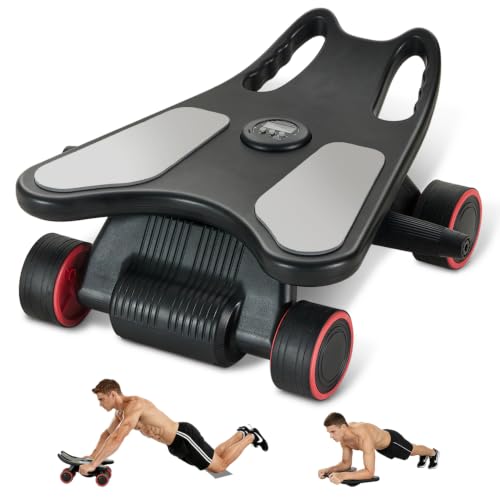
- Four wheels improve balance during rollouts
- Spring-assisted rebound supports the return motion
- Elbow supports, knee mat, and timer are included
Best For: Beginners wanting guided, timed home workouts
Best Portable Kit

- 2.8-inch dual wheels provide steady control
- Includes a thick knee pad for comfort
- Lightweight design supports home, office, or travel use
Best For: Portable core circuits with simple knee support
Stable Starter – Vinsguir Dual-Wheel Ab Roller
For shoppers comparing ab rollers for circuit training, this dual-wheel Vinsguir model emphasizes stability and straightforward setup. Its 3.2-inch-wide wheel, nonslip handles, and included knee pad make it a practical choice for adding controlled core work to a home, gym, office, or outdoor circuit.
Best For: Beginners and intermediate users who want a stable, portable ab roller with knee support.
Pros:
- Dual-wheel design and 3.2-inch width provide added balance.
- Includes a knee pad for more comfortable rollouts.
- Stainless steel shaft is rated for up to 440 pounds.
- Compact build includes comfortable EVA rubber-cotton handles.
Cons:
- It focuses on ab-roller training rather than providing multiple circuit accessories.
- Users seeking a more advanced balance challenge may prefer a narrower wheel.
Overall, this is a sensible circuit-training pick when stability, portability, and knee comfort matter more than extra attachments.
Full Circuit Kit – TOMSHOO 6-in-1 Ab Roller Set
If your circuit needs more than core work, the TOMSHOO 6-in-1 set combines an ab roller with several compact training tools. The package includes a jump rope, hand gripper, push-up bars, and knee mat, allowing you to build varied home circuits without bulky equipment.
Best For: Users who want a complete, space-saving home circuit kit alongside their ab roller.
Pros:
- Includes an ab roller, jump rope, hand gripper, two push-up bars, and knee mat.
- Longer handle pipe and foam grips support stability during rollouts.
- Push-up bars are designed to detach or mount quickly.
- Knee mat adds protection during core exercises.
Cons:
- The set may be more equipment than shoppers seeking only an ab wheel need.
- Its stated 800-pound maximum recommendation is not separately tied to each accessory.
This is the most versatile option in the group for alternating ab rollouts with push-ups, jumping, and grip work in one circuit.
Maximum Support – Extra-Wide Ab Roller with Two Knee Pads
For ab rollers for circuit training that prioritize traction and user comfort, this model pairs a 3.1-inch wheel with a textured surface and two adjustable knee pads. Its portable construction also makes it easy to add rollouts to home, office, gym, or travel workouts.
Best For: Users who want strong floor grip, adjustable knee positioning, and a high stated weight capacity.
Pros:
- Textured wheel surface is designed to increase friction and reduce slipping.
- Two adjustable knee pads allow width customization.
- Stainless steel rod supports a stated maximum of 600 pounds.
- EVA foam handles help reduce hand fatigue.
Cons:
- It provides one primary training tool rather than a multi-accessory kit.
- Assembly is required, although the product notes specify four steps.
With its combination of traction, adjustable knee support, and portability, this roller suits circuits where repeatable, controlled rollouts are the main core movement.
Advanced Balance – AGREJO Narrow Ab Roller
The AGREJO is aimed at shoppers who want ab rollers for circuit training with a greater balance demand. Its slightly rounded, 1.97-inch-wide wheel encourages dynamic stability while its textured surface, grooved EVA handles, and steel core support controlled home-gym rollouts.
Best For: More experienced users seeking a narrower wheel for advanced balance and stability work.
Pros:
- Narrow, slightly rounded wheel increases the balance challenge.
- Textured wheel is designed to grip different floor surfaces.
- Strong steel core supports up to 500 pounds.
- Finger-grooved EVA handles provide a comfortable grip.
Cons:
- The 1.97-inch width may feel less forgiving for beginners.
- It does not include a knee pad or additional circuit accessories.
This is the focused choice for progressing balance and dynamic stability, provided you are comfortable with a less-supportive wheel design.
Adjustable Stability Pick – Ally Peaks Auto-Rebound Ab Roller
For shoppers comparing ab rollers for circuit training, the Ally Peaks model stands out for its adjustable assistance and wide dual-wheel base. The removable resistance band lets you scale the challenge, while the 4.4-inch tread is designed for added stability across common home flooring.
Best For: Beginners, mixed-level households, and circuits that alternate assisted and unassisted core work.
Pros:
- Adjustable, removable resistance band provides multiple difficulty options.
- Wide dual-wheel design and grooved EVA tread support stability and traction.
- Stainless steel shaft supports up to 440 pounds and includes a foldable knee pad.
Cons:
- The resistance-band system adds more parts than a basic ab wheel.
- Its 4.4-inch dual-wheel setup may feel less challenging than a narrower wheel for advanced users.
This is a flexible circuit-training choice when progression matters. Start with band assistance, then remove the band or reduce the wheel setup as your control improves.
Advanced Control Pick – Vinsguir Ab Roller Wheel
Among ab rollers for circuit training, the Vinsguir wheel is aimed at users who want a more demanding balance and control exercise. Its slightly rounded, 2-inch wheel creates a smaller contact area, while the textured surface and grooved EVA handles support confident repetitions.
Best For: Experienced users adding challenging rollouts to strength circuits and home-gym sessions.
Pros:
- Narrow, slightly rounded wheel increases balance and dynamic-stability demands.
- Textured tread is designed to grip a variety of floor surfaces.
- Steel core and EVA-covered handles provide a durable, comfortable setup.
- Partially assembled design only requires handle installation.
Cons:
- The narrower wheel offers less inherent stability for beginners.
- Handle installation may be easier with water or soapy water on the steel pipe.
Choose this model when your circuit already includes controlled core work and you want the roller itself to demand more precision. Beginners may prefer a wider dual-wheel design first.
Simple Wide-Wheel Pick – Abiarst Ab Roller
The Abiarst is a practical option for ab rollers for circuit training when you want a compact tool with extra support. Its 3.2-inch dual-wheel layout is wider than a typical single wheel, and the included knee pad accessories make it easy to add rollouts to home, office, gym, or outdoor circuits.
Best For: Users who want a portable, wide-wheel roller for general abdominal and core-strength circuits.
Pros:
- 3.2-inch dual-wheel design provides added support and stability.
- Stainless steel shaft is rated to support up to 500 pounds.
- EVA handles offer a nonslip, comfortable grip.
- Compact construction is convenient for training in multiple locations.
Cons:
- It does not list adjustable resistance assistance for scaling exercises.
- Users seeking a highly advanced balance challenge may prefer a narrower wheel.
The Abiarst balances stability, portability, and straightforward setup. It is a sensible circuit accessory for repeated core work, especially when you want a wider base without carrying bulky gym equipment.
Most Stable Pick – Ultra-Wide Dual-Wheel Ab Roller
For shoppers comparing ab rollers for circuit training, this model emphasizes stability, traction, and a substantial weight capacity. Its 3.4-inch dual wheels and tire-inspired tread are designed to help maintain control across floors ranging from hardwood to carpet.
Best For: Beginners and home-gym users who want a stable, heavy-duty roller for core and full-body circuits.
Pros:
- Extra-wide dual wheels help reduce wobbling and tipping.
- Textured wheels provide grip on multiple floor types.
- High-carbon steel construction supports up to 440 pounds.
- Compact design and cushioned, non-slip handles are convenient for storage and repeated use.
Cons:
- It does not include the elbow supports or timer found on some assisted models.
- The one-piece design may offer fewer setup adjustments.
This is a straightforward choice when stability and durability matter most. The wide wheelbase and grippy tread can make controlled rollouts more approachable, while the compact build suits small home gyms and travel.
Best Assisted Design – Auto-Rebound Ab Roller with Elbow Support
Among ab rollers for circuit training, this four-wheel model stands out for its assisted return and elbow supports. The built-in spring helps with the backward movement, while the timer and quiet wheel construction are suited to structured home workouts.
Best For: Beginners who want extra support and a timer for interval-style core circuits.
Pros:
- Elbow supports can improve stability and reduce arm compensation.
- Automatic rebound assistance helps with the return phase.
- Four wheels are designed to minimize side-to-side sway.
- Includes a knee mat and large-screen timer for added workout convenience.
Cons:
- The plastic construction has a listed maximum weight recommendation of 20 pounds, so buyers should verify suitability carefully.
- Its assisted design may provide a different training feel than a traditional wheel.
This option is geared toward guided, lower-strain rollouts rather than a minimalist roller experience. Its elbow support, rebound mechanism, and timer make it particularly practical for beginners building repeatable circuits at home.
Best Portable Kit – Compact Dual-Wheel Ab Roller
This compact option is a practical addition to ab rollers for circuit training when portability and basic stability are priorities. Its 2.8-inch dual wheels, steel tube, cushioned handles, and included knee pad support controlled workouts at home, in the office, or while traveling.
Best For: Users who want a lightweight, travel-friendly roller with knee support and a high listed weight recommendation.
Pros:
- Dual wheels provide steadier control than a standard single-wheel design.
- Stainless steel shaft and steel tube construction are suited to frequent use.
- Soft EVA handles help reduce hand fatigue.
- Includes a thick knee pad and supports up to 500 pounds according to the listing.
Cons:
- The 2.8-inch wheels are narrower than the 3.4-inch wheels on the most stability-focused option.
- It does not include a timer or rebound-assistance mechanism.
Choose this roller for a simple, portable setup that covers the essentials. The included knee pad adds comfort, and the lightweight construction makes it easy to keep consistent core circuits beyond the home gym.
How We Picked the Best Ab Rollers for Circuit Training
We focused on features that matter when an ab roller is used repeatedly within a circuit rather than as a standalone exercise. Our comparison considered wheel stability, handle comfort, rebound or resistance assistance, included knee support, portability, and suitability for beginners through experienced trainees. We also looked for practical equipment that can be stored easily and used on an appropriate indoor workout surface.
Because product configurations can vary, check the current listing for exact dimensions, included accessories, weight limits, and assembly details before buying.
Quick Comparison
| Type | Best For | Main Advantage | Potential Trade-Off |
|---|---|---|---|
| Standard single-wheel roller | Experienced users and simple home circuits | Compact, affordable, and straightforward | Requires more balance and control |
| Wide or four-wheel roller | Beginners seeking extra stability | More predictable tracking | Can feel less agile during advanced work |
| Automatic-rebound model | New users or high-repetition circuits | Assists the return phase | May provide less challenge for strong users |
| Multi-function kit | Home gyms needing versatility | May include accessories for varied exercises | More parts to store and evaluate |
Key Buying Factors for Ab Rollers for Circuit Training
Stability and Wheel Tracking
A wider wheel or multiple-wheel design can reduce side-to-side movement, which is useful when fatigue builds across a circuit. Narrow wheels may offer a greater balance challenge but demand stronger control and cleaner technique.
Return Assistance and Resistance
Automatic-rebound systems can help beginners complete the return phase safely and maintain a steady pace. They are also useful for volume-based circuits, but advanced users may prefer a conventional wheel that requires full control throughout the rollout.
Handles and Grip
Look for handles that feel secure and remain comfortable during repeated sets. Firm, non-slip grips can reduce hand fatigue and help you keep your wrists aligned.
Knee Protection and Floor Compatibility
A knee pad is valuable for kneeling rollouts, especially on hard floors. Check that the wheel material suits your surface and use a mat if the tread may mark flooring or lose traction.
Storage and Workout Versatility
For circuit training, compact equipment is easier to keep near other workout stations. Multi-function sets may add value if you will use their accessories, while a basic roller is often the better choice for focused core training.
Who Should Buy Which Ab Rollers for Circuit Training?
Beginners: Choose a wider, multi-wheel, or automatic-rebound model with a knee pad and controlled return assistance.
Intermediate users: A stable standard roller or adjustable-resistance design can support progressive rollouts, timed intervals, and mixed-bodyweight circuits.
Advanced users: Favor a responsive single-wheel model with strong handles and smooth tracking, provided you can maintain a neutral spine and controlled range of motion.
Small-space home gyms: Select a compact roller that stores easily and works reliably on your available floor surface. Whichever model you choose, begin with short rollouts, brace your core, and stop before your lower back arches.