Small rooms can heat up quickly, but the right window fan can improve airflow without taking up valuable floor space. The best models balance a compact fit with useful controls, quiet operation, and enough airflow for bedrooms, offices, and apartments.
We compared 10 window fans for small rooms across reversible airflow, installation flexibility, speed settings, controls, and everyday usability so you can choose a model that matches your window and cooling needs.
Best 10 Window Fans for Small Rooms Picks for 2026
Best Overall
Bionaire Programmable Window Fan

- Reversible airflow blades
- Programmable thermostat and remote
- Fits 24–36-inch windows
Best For: Small rooms needing flexible, temperature-aware ventilation
Best Adjustable Fit
COMFORT ZONE Reversible Twin Fan

- Reversible airflow operation
- Three speed settings
- Expandable window width
Best For: Rooms needing a flexible twin-fan window installation
Best Simple Option

- Compact 9-inch format
- Three speed settings
- Frameless white design
Best For: Small rooms needing basic, compact airflow
Best Rotatable Design
shinic Adjustable Vertical Window Fan

- 180°+90° rotatable fans
- Manual reversible airflow
- Adjusts from 21.65–33.27 inches
Best For: Small rooms needing directional and width-adjustable ventilation
Simple Dual-Airflow Pick
BLACK+DECKER 9-inch Window Fan

- 9-inch dual-fan design
- Two speed settings
- Straightforward white finish
Best For: Small rooms needing simple dual-fan ventilation
Feature-Rich Twin Fan
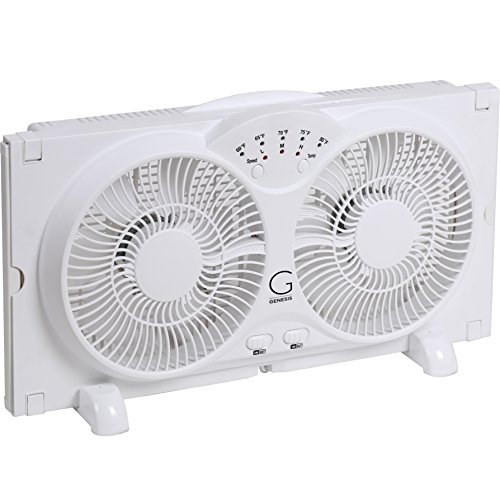
- Reversible airflow
- Adjustable thermostat
- LED indicators and Max Cool Technology
Best For: Small rooms needing flexible airflow control
Quiet Adjustable Pick

- Low-noise twin-fan design
- Reversible airflow
- Fits 23.5"-37" windows
Best For: Small rooms needing a quieter, adjustable window fan
Budget Twin-Fan Option

- Reversible airflow and exhaust
- Expandable side panels
- Two speed settings
Best For: Bedrooms and compact spaces needing basic adjustable airflow
Best Overall – Bionaire Programmable Window Fan
For shoppers comparing window fans for small rooms, the Bionaire stands out for its reversible airflow, thermostat controls, and included remote. Its 24–36-inch window fit and no-assembly design make it a convenient option when you want flexible ventilation without a complicated setup.
Best For: Small rooms where programmable temperature control and remote operation are priorities.
Pros:
- Reversible airflow blades support intake or exhaust ventilation.
- Three speed settings provide airflow flexibility.
- Programmable thermostat, LED display, and remote control add convenience.
- No assembly is required.
Cons:
- Its 24–36-inch window-fit range may not suit smaller or unusually sized windows.
- More controls may be unnecessary for shoppers seeking a basic fan.
The Bionaire is a feature-rich pick for buyers who want more control than a simple window fan provides. Confirm your window width before ordering.
Best Adjustable Fit – COMFORT ZONE Reversible Twin Fan
The COMFORT ZONE reversible twin fan is a practical choice among window fans for small rooms when adjustable installation matters. Its expandable width and twin-fan design offer flexible ventilation across different window setups.
Best For: Small rooms with windows that benefit from an expandable fan fit and reversible airflow.
Pros:
- Twin-fan configuration supports broad airflow coverage.
- Reversible operation allows airflow direction changes.
- Three speed settings provide adjustable ventilation.
- Expandable width helps accommodate different window sizes.
Cons:
- The supplied details do not specify the exact expansion range.
- Twin-fan construction may be more than needed for very compact windows.
This model suits shoppers who value installation flexibility and straightforward airflow control. Measure the window opening carefully, since the exact fit range is not provided here.
Best Simple Option – BLACK+DECKER 9-Inch Box Fan
The BLACK+DECKER 9-inch frameless box fan keeps things simple for shoppers looking at window fans for small rooms. With three speeds and a compact 9-inch format, it is suited to buyers who prefer basic airflow control over added window-fan features.
Best For: Small rooms where a compact, straightforward three-speed fan is the main requirement.
Pros:
- Compact 9-inch size is appropriate for smaller spaces.
- Three speed settings allow basic airflow adjustment.
- Frameless box-fan design offers a simple appearance.
- White finish blends with many room setups.
Cons:
- The supplied details do not identify a reversible airflow function.
- No window-fit range or expansion feature is specified.
- It may offer fewer dedicated window-installation features than the other listed models.
Choose this BLACK+DECKER model if compact sizing and uncomplicated controls matter most. Verify how it will fit or be positioned in your particular window before purchase.
Best Rotatable Design – shinic Adjustable Vertical Window Fan
The shinic vertical window fan offers useful positioning flexibility for small rooms, with rotatable fans, manual reversal, and an adjustable 21.65–33.27-inch width. Its rigid and accordion expanders are designed to help it accommodate a range of window openings.
Best For: Bedrooms, kitchens, and other small rooms where adjustable width and directional airflow are important.
Pros:
- Two fans rotate 180°+90° for directional positioning.
- Manual reversible operation supports intake or exhaust airflow.
- Three speed settings provide adjustable ventilation.
- Width adjusts from 21.65 to 33.27 inches and includes rigid and accordion expanders.
Cons:
- Airflow reversal is manual rather than automatic.
- The adjustable components may require more setup attention than a fixed-width design.
With its wide adjustment range and rotatable fans, the shinic is a strong fit when window dimensions and airflow direction vary. Measure the opening to ensure it falls within the stated range.
Simple Dual-Airflow Pick – BLACK+DECKER 9-inch Window Fan
The BLACK+DECKER BFW9M is a straightforward option for shoppers comparing window fans for small rooms. Its 9-inch dual-fan design and two speed settings keep the controls simple for everyday ventilation.
Best For: Small rooms where a compact dual-fan setup and uncomplicated speed control are priorities.
Pros:
- Dual-fan design in a 9-inch format
- Two speed settings for basic airflow adjustment
- Simple white finish that suits many room setups
Cons:
- Only two speed settings
- Does not offer the additional features listed for some competing models
This is a practical, no-frills choice if you want a compact window fan for small rooms without a long list of controls or features.
Feature-Rich Twin Fan – Genesis Reversible Window Fan
The Genesis A1WINDOWFAN stands out among window fans for small rooms with reversible airflow, LED indicator lights, an adjustable thermostat, and Max Cool Technology. Its twin-fan layout gives shoppers more control over how they manage room ventilation.
Best For: Small rooms where reversible airflow and extra control features are more important than a minimalist design.
Pros:
- Reversible airflow for intake or exhaust use
- Adjustable thermostat for temperature-based control
- LED indicator lights and Max Cool Technology
- ETL certified
Cons:
- More features may be unnecessary for shoppers seeking the simplest setup
- The product title does not specify a speed-setting count
Choose this model when airflow direction and thermostat control matter. It offers a broader feature set than a basic twin window fan while retaining a compact-room focus.
Portable Compact Option – 10-inch Small Box Window Fan
This 10-inch small box fan is a flexible choice for shoppers seeking window fans for small rooms, offices, bedrooms, apartments, or living rooms. It has three speeds, strong airflow, a DC adapter, a 5-foot power cord, and a lightweight design for convenient placement.
Best For: Users who want a lightweight 10-inch fan that can work on a table or in a compact room setup.
Pros:
- Three speed settings for more airflow adjustment
- Lightweight and described as quiet
- Includes a 5-foot power cord and DC adapter
- Suitable for office, bedroom, living room, or apartment use
Cons:
- The product title does not specify a reversible airflow function
- Its 10-inch size may be less suitable where the smallest possible footprint is required
With three speeds and portable power details, this model is a versatile pick for compact spaces where you may want to move the fan between a window, desk, or table.
Quiet Adjustable Pick – Shinic 9" Twin Window Fan
For shoppers comparing window fans for small rooms, the Shinic 9-inch twin-fan design offers reversible airflow, low-noise operation, and an expandable 23.5- to 37-inch fit range.
Best For: Small rooms needing a quieter twin-fan setup with flexible window-width compatibility.
Pros:
- Low-noise design
- Reversible airflow
- Adjustable 23.5- to 37-inch width
- ETL certification
Cons:
- The 9-inch fan size may provide less airflow than larger window fans.
- The supplied information does not specify speed settings or remote control.
Its adjustable fit and low-noise construction make this a practical option when window compatibility and quieter operation matter more than extensive controls.
Feature-Rich Choice – Vornado TRANSOM Window Fan
Among window fans for small rooms, the Vornado TRANSOM stands out for its four speeds, remote control, reversible exhaust mode, and weather-resistant case.
Best For: Small rooms where convenient controls, multiple speeds, and exhaust capability are priorities.
Pros:
- Four speed settings
- Includes a remote control
- Reversible exhaust mode
- Weather-resistant case
Cons:
- The supplied information does not specify the window-width range.
- The supplied information does not identify the number or size of fans.
This is the strongest control-focused choice in the group, especially for users who want to adjust airflow from across the room and switch to exhaust mode when needed.
Budget Twin-Fan Option – Amazon Basics 9" Window Fan
The Amazon Basics 9-inch twin window fan is a straightforward option for window fans for small rooms, with reversible airflow, exhaust mode, expandable side panels, and two speeds.
Best For: Bedrooms and other small spaces needing basic reversible air circulation with an adjustable fit.
Pros:
- Reversible airflow and exhaust mode
- Expandable side panels for width adjustment
- Two speed settings
- Designed for home and bedroom use
Cons:
- Only two speeds are listed.
- The supplied information does not specify the adjustable width range.
- The supplied information does not mention a remote control.
With its twin-fan layout and expandable panels, this model covers the essentials without adding controls that are not listed, making it a practical basic choice for a bedroom or compact room.
How We Picked the Best Window Fans for Small Rooms
We focused on models suited to compact living spaces rather than oversized whole-house ventilation. Our selection includes single and twin-fan designs, box fans, and window-specific units with adjustable side panels or expanders. We considered airflow control, reversible intake and exhaust modes, installation range, noise-related features, thermostats, remotes, and power options.
Because window dimensions vary, fit was treated as a major factor. A fan with expandable panels may work in a wider range of windows, while a compact box fan or frameless design may be more convenient for narrow openings or occasional placement on a table.
Quick Comparison
- Best for automatic comfort: Choose a model with a thermostat, LED display, and remote control.
- Best for ventilation: Look for reversible airflow or separate intake and exhaust functions.
- Best for flexible installation: Select expandable side panels or rigid and accordion-style window expanders.
- Best for simple cooling: A three-speed box fan offers straightforward operation and easy portability.
- Best for broader room circulation: A higher-output model with multiple speeds may move air more effectively in an open bedroom or studio.
Key Buying Factors for Window Fans for Small Rooms
Window Size and Fit
Measure the usable opening, not just the overall window frame. Check both minimum and maximum supported widths, and confirm whether the fan is designed for horizontal or vertical installation. Expandable panels help reduce gaps, but they do not replace proper support and secure placement.
Airflow Direction
Reversible fans can bring cooler outdoor air inside, push warm indoor air out, or alternate between the two. This is especially useful at night or when a room needs ventilation after cooking. Manual reversal is simple, while electronic or remote-controlled reversal is more convenient.
Noise and Speed Control
Bedrooms and home offices benefit from multiple speed settings and low-noise operation. More speeds provide finer control, but fan noise can still vary by design and installation. A stable, snug fit helps limit vibration.
Controls and Convenience
Remote controls, programmable thermostats, LED indicators, and timer functions can make a noticeable difference during daily use. If you prefer fewer electronics, manual controls are typically simpler and easier to operate.
Safety and Weather Exposure
Use the fan only as directed by the manufacturer, keep electrical connections dry, and avoid leaving an indoor-rated unit exposed to rain. Look for certifications and a secure installation method, particularly in frequently opened windows.
Who Should Buy Which Window Fans for Small Rooms?
For a bedroom: Choose a quieter model with several speeds, a thermostat, or a remote so you can adjust airflow without getting up.
For a small office: A compact box fan or slim window fan is practical when portability and simple controls matter more than automatic settings.
For an apartment: Prioritize adjustable panels and reversible airflow to accommodate different windows and improve ventilation without permanent installation.
For a narrow or unusually oriented window: Check vertical-installation support and the included expanders before buying.
For maximum flexibility: Pick a twin reversible fan with independent or multiple airflow modes, especially if you want to cool the room and exhaust stale air with one unit.