Running puts repeated stress on the calves, Achilles tendons, plantar fascia, and feet. The right stretching tool can make post-run mobility work more consistent by providing a stable angle, controlled leverage, or targeted foot support.
This roundup compares 10 calf stretchers for runners, from compact rockers and straps to adjustable wooden slant boards. Use the buying guide below to match the design, adjustability, and capacity to your training routine.
Best 10 Calf Stretchers for Runners Picks for 2026
Classic Foot-Rocker Pick

- Rocking design targets tight calves and lower-leg muscles
- Slip-resistant pads help keep the stretcher stable
- Fits adult shoes up to size 12; 250-pound recommended limit
Best For: Runners wanting a compact, dedicated foot rocker
Adjustable Rehab Board

- Five incline settings from 15 to 35 degrees
- Anti-slip treads and a side handle support practical use
- Wood construction is suited to stretching and rehab exercises
Best For: Runners seeking adjustable angles and a sturdy platform
Lightweight Foot-Rocker Option

- Supports stretching and strengthening of the foot and lower leg
- Non-skid rocker bottom helps maintain a stable position
- Lightweight, compact design is easy to store
Best For: Runners wanting a portable foot and calf rocker
Portable Multi-Angle Board

- Five angles from 23 to 45 degrees support progression
- Folds and weighs 4.6 pounds for easier transport
- Includes a workout poster and instructions
Best For: Runners needing a portable, adjustable slant board
Best Customizable Option

- Adjustable heel rest for varied intensity
- Removable toe lift targets toes and plantar fascia
- Slip-resistant platform; fits shoes up to size 14
Best For: Runners wanting adjustable calf, foot, and plantar-fascia stretching
Best Adjustable Slant Board
Portable Wooden Calf Stretch Board

- Five angles from 23° to 45°
- 460-pound stated capacity with non-slip surfaces
- Portable, assembled design with training guide
Best For: Runners needing adjustable calf and ankle mobility work
Best Portable Strap
Comness Foot and Calf Stretch Strap
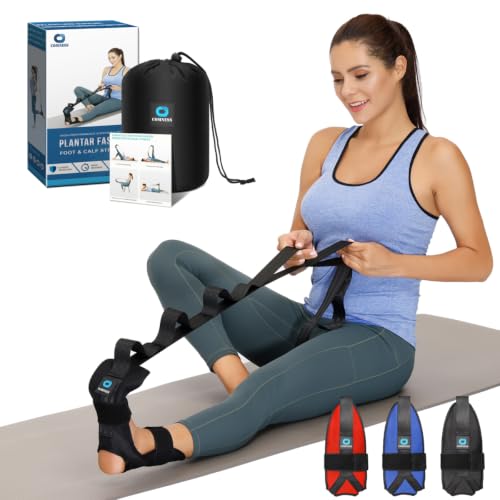
- Six-loop design supports multiple positions
- 60-inch strap includes carrying pouch
- Targets feet, calves, hamstrings, and thighs
Best For: Runners seeking compact stretching equipment for travel or home
Therapy-Inspired Deep Stretch

- Heel-lock design for a deeper, controlled stretch
- 300+ lb heavy-duty ABS construction
- Folds flat with a slip-resistant heel pad
Best For: Runners seeking targeted calf and ankle mobility work
High-Capacity Training Wedge

- 1,000-pound maximum weight recommendation
- Supports stretching, balance, squats, and mobility
- Compact EVA wedge design
Best For: Runners wanting a simple multipurpose training wedge
Adjustable Angle Mobility

- Four incline settings from 30° to 45°
- Supports stretching, squats, and rehabilitation
- Portable wood design for home, gym, or clinic
Best For: Runners who want adjustable stretch intensity and exercise versatility
Classic Foot-Rocker Pick – ProStretch Original
For runners looking for calf stretchers for runners that target the lower leg without much setup, the ProStretch Original uses a rocker design to position the foot for a focused stretch. Its slip-resistant rubber strips help keep it stable while you work on tight calves, hamstrings, or foot and heel discomfort.
Best For: Runners who want a compact, physician-trusted foot rocker for regular calf and foot stretching.
Pros:
- Rocker design helps hold the foot in an effective stretching position.
- Slip-resistant pads help prevent movement on different surfaces.
- Made in the U.S.A. and includes a stretching guide via QR code.
- Suitable for adult shoes up to size 12 and users up to 250 pounds.
Cons:
- Requires socks and rubber-soled athletic shoes for use.
- Its fit and weight guidance may not suit every user.
This is a straightforward choice for runners who prefer a dedicated foot rocker over a larger slant board. The compact design and stability features make it practical for consistent post-run stretching.
Adjustable Rehab Board – StrongTek Wooden Slant Board
The StrongTek Wooden Slant Board is a larger option among calf stretchers for runners, offering five incline settings from 15 to 35 degrees. Its wooden platform, anti-slip treads, and side handle make it useful for warm-ups, cooldowns, recovery work, and selected lower-body exercises.
Best For: Runners who want adjustable incline levels and a sturdy board for stretching, recovery, and rehab-style exercises.
Pros:
- Five angle settings allow users to adjust stretching intensity.
- Anti-slip safety treads support a more secure stance.
- High-quality hardwood plywood construction is designed for durability.
- Side handle improves portability, and no assembly is required.
Cons:
- At 9 pounds, it is heavier than compact foot-rocker designs.
- The larger platform requires more storage space.
This board suits runners who value adjustability and a broader standing surface. It is less travel-friendly than a small rocker but offers more flexibility for progressive stretching and exercise routines.
Lightweight Foot-Rocker Option – PowerStep UltraFlexx
The PowerStep UltraFlexx is a compact choice for runners comparing calf stretchers for runners and foot-focused recovery tools. Its rocker holds the foot in position for stretching and strengthening, while the non-skid base helps provide stability during use with sturdy athletic shoes.
Best For: Runners who want a lightweight rocker for calf, foot, Achilles, plantar fascia, and shin-splint-related stretching.
Pros:
- Designed to stretch and strengthen the foot and lower-leg muscles, ligaments, and tendons.
- Non-skid rocker bottom helps hold the foot steady.
- Lightweight construction weighs about 0.4 kilograms.
- Compact dimensions make it easy to store between training sessions.
Cons:
- It is recommended for use with sturdy athletic shoes.
- Its one-position rocker design offers less angle adjustment than a slant board.
The UltraFlexx is a practical fit for runners who want a simple, portable stretching aid rather than a full-size platform. Its emphasis on both flexibility and strengthening adds versatility to lower-leg maintenance.
Portable Multi-Angle Board – Adjustable Calf Stretch Board
This portable slant board gives runners five selectable angles—23, 30, 35, 40, and 45 degrees—to vary calf and lower-leg stretching. It folds for transport, needs no setup, and can be used with one or both feet at home, at the gym, or during travel.
Best For: Runners who want a lightweight, foldable board with multiple intensity levels for calves, ankles, heels, and legs.
Pros:
- Five angle settings provide progression from easier to more challenging stretches.
- Foldable 4.6-pound design is convenient for transport.
- Can be used with one or both feet and supports several lower-body stretches.
- Includes a workout poster and instructions.
Cons:
- No warranty is listed in the supplied product details.
- The recommended maximum weight is 300 pounds, so heavier users should check fit carefully.
For runners who need adjustable calf stretchers for runners that can move between locations, this board combines angle variety with portability. Its broad range of settings also makes it suitable for gradual progression.
Best Customizable Option – Adjustable ProStretch Plus
For runners seeking calf stretchers for runners that also address foot and heel discomfort, the ProStretch Plus combines a foot rocker with an adjustable heel rest. Its removable toe lift and slip-resistant platform let you tailor the stretch for regular mobility work.
Best For: Runners who want an adjustable calf and foot stretcher for tight calves, plantar fascia, or Achilles-focused routines.
Pros:
- Adjustable heel rest helps vary stretch intensity.
- Removable toe lift can add a deeper toe and plantar fascia stretch.
- Wide, slip-resistant platform supports use on different surfaces.
- Lightweight design fits adult shoes up to size 14 and supports up to 300 pounds.
Cons:
- Requires socks and rubber-soled athletic shoes.
- Designed for one foot at a time rather than a two-foot stance.
- Its focus on foot and plantar-fascia stretching may be more than runners seeking only a basic calf stretch need.
The ProStretch Plus is a versatile choice when you want to adjust the stretch rather than use a fixed-angle board. The included guide and removable toe lift add flexibility for runners building a broader lower-leg routine.
Best Adjustable Slant Board – Portable Wooden Calf Stretch Board
This slant board is a practical option among calf stretchers for runners, especially for warm-ups, cooldowns, and lower-body mobility. Five angle settings let you choose a gentler or more intensive incline, while the wooden design folds for transport.
Best For: Runners who want a portable, adjustable board for calf stretching, ankle mobility, and squat variations.
Pros:
- Offers five incline settings from 23° to 45°.
- Textured PVC surface and EVA base help provide traction.
- Supports up to 460 pounds while weighing about 4.5 pounds.
- Arrives assembled and includes a training poster and instruction guide.
Cons:
- Its 15.75-by-11.8-inch footprint may be less convenient for very limited spaces.
- Angle adjustment requires placing the support panel into a selected slot.
- The supplied notes do not specify a built-in handhold or carrying case.
With its broad angle range and high stated weight capacity, this board can suit both gradual stretching and more demanding mobility sessions. It is also useful beyond calf work, including ankle routines and heel-elevated squats.
Best Portable Strap – Comness Foot and Calf Stretch Strap
For runners who prefer a lightweight tool, this strap offers a flexible alternative to rigid calf stretchers for runners. Its cradle design and six-loop webbing support several foot, calf, hamstring, and lower-body stretching positions at home, the gym, or while traveling.
Best For: Runners who want a compact, on-the-go strap for foot, calf, hamstring, and ankle stretching.
Pros:
- Portable 60-inch strap includes a carrying pouch.
- Six-loop webbing supports different stretching positions.
- Cradle design uses nylon laminate and is intended to improve comfort.
- Can be used for foot, calf, hamstring, thigh, and lower-back flexibility work.
Cons:
- Requires active hand control rather than providing a standing platform.
- One-size design may not offer the same fit customization as an adjustable rocker.
- Users must follow the instructions to learn the different orientations and positions.
The Comness strap is a strong fit for runners who value packability and exercise versatility over a fixed, weight-bearing stretcher. Its pouch and looped design make it easy to add stretching to travel or post-run routines.
Therapy-Inspired Deep Stretch – CalfPRO Slant Board
For runners comparing calf stretchers for runners, the CalfPRO stands out for its heel-lock design, which is intended to create a deeper, controlled calf stretch than a basic wedge. It folds flat, requires no assembly, and can be used before workouts, after training, or during daily mobility routines.
Best For: Runners who want a portable, physical-therapy-inspired stretcher for calf, ankle, Achilles, and foot mobility work.
Pros:
- Patented heel lock holds the heel as a fixed pivot for a deeper stretch.
- Heavy-duty ABS construction is rated to hold over 300 pounds.
- Folds flat and includes a slip-resistant heel pad for portability and stability.
- Designed for warmups, recovery, plantar-fasciitis support, and Achilles stretching.
Cons:
- Its specialized design may be less versatile than a fully adjustable slant board.
- At 1.89 kg, it is portable but not the lightest option in this roundup.
The CalfPRO is a strong choice when controlled positioning and a deeper stretch matter most. Its door-jam groove and heel pad add stability, while the fold-flat construction makes it practical for gym bags and travel.
High-Capacity Training Wedge – EVA Calf Stretch Board
This EVA slant board is a straightforward option for runners who want calf stretchers for runners that can also support balance, squats, and mobility drills. Its compact 16-by-6.5-inch design offers a stable wedge for stretching and lower-leg conditioning.
Best For: Runners who want a simple, high-capacity wedge for calf stretching, ankle mobility, balance work, and squat training.
Pros:
- Maximum weight recommendation of 1,000 pounds.
- Supports calf stretching, ankle mobility, flexibility, and balance exercises.
- Can be used for plantar-fasciitis, Achilles, shin-splint, and tight-hamstring routines.
- EVA construction provides a lightweight, compact format.
Cons:
- The fixed wedge does not offer adjustable incline positions.
- Its narrow 6.5-inch width may provide less foot space than larger boards.
Choose this model if you prefer a basic, durable-feeling wedge with a particularly high stated weight capacity. It is suited to runners who want one tool for stretching and fitness drills without added mechanisms.
Adjustable Angle Mobility – Portable Wooden Slant Board
For runners who want adjustable calf stretchers for runners, this wooden slant board offers four incline settings from 30 to 45 degrees. The portable board is designed for stretching, squats, weight-bearing exercises, and rehabilitation work at home, in the office, gym, or clinic.
Best For: Runners who want adjustable incline angles and a versatile board for stretching, strengthening, and recovery exercises.
Pros:
- Four adjustable positions: 30°, 35°, 40°, and 45°.
- Supports calf, ankle, heel, knee, and lower-leg mobility routines.
- Suitable for beginners, experienced athletes, and rehabilitation settings.
- Portable design weighs about 4.5 to 5 pounds.
Cons:
- Wood construction may be less compact than a fold-flat stretcher.
- The supplied notes do not specify a maximum weight capacity.
- Adjusting the incline requires selecting among preset positions rather than continuous adjustment.
This is the most flexible choice of the three for users who want to vary stretch intensity. The multiple angles make it useful for gradually progressing mobility work or combining calf stretching with squats and other weight-bearing exercises.
How We Picked the Best Calf Stretchers for Runners
We focused on tools designed to improve calf, ankle, foot, or Achilles mobility rather than general exercise equipment. The selection includes dedicated stretchers, foot rockers, slant boards, and stretching straps so runners can compare different approaches. We considered adjustability, portability, stability, materials, weight capacity, ease of use, and whether each design can support gradual, controlled stretching.
Because foot and lower-leg discomfort can have different causes, these products are not substitutes for medical evaluation. Stop if stretching causes sharp pain, numbness, or worsening symptoms.
Quick Comparison
| Design | Best for | Main advantage | Potential limitation |
|---|---|---|---|
| Foot rocker | Targeted foot and calf work | Simple positioning and leverage | Usually less adjustable |
| Slant board | Progressive calf stretching | Adjustable incline and stable stance | Requires more storage space |
| Stretching strap | Portability and assisted stretching | Lightweight and inexpensive | Needs active positioning and control |
| Wooden incline board | Home recovery routines | Durable, supportive platform | Can be heavier than plastic tools |
Key Buying Factors for Calf Stretchers for Runners
Adjustability
A fixed-angle tool can be convenient, but adjustable boards are better if you are managing tightness, returning from a layoff, or sharing the equipment. Multiple incline settings let you start gently and increase the stretch gradually.
Stability and Traction
Look for a broad base, non-slip surfaces, side handles, or secure foot channels. A stable platform helps you relax into the stretch without compensating through the knees, hips, or lower back. Use any board on a firm, level floor.
Size, Portability, and Storage
Runners who travel or attend races may prefer a compact rocker or strap. A slant board is often more stable for regular home use, but check its dimensions and weight before buying.
Capacity and Construction
Check the stated weight limit and inspect the platform, hinges, adjustment points, and grip material. A higher capacity does not automatically mean better performance, but it can provide an additional safety margin and improve long-term durability.
Stretching Position
Consider whether you want a standing stretch, seated foot stretch, or assisted range-of-motion work. Standing boards usually provide stronger leverage, while rockers and straps may offer more targeted control.
Who Should Buy Which Calf Stretchers for Runners?
- Choose a slant board if you want a stable, repeatable standing stretch with adjustable intensity for regular post-run recovery.
- Choose a foot rocker if you want a compact tool for focused calf, arch, or plantar fascia mobility.
- Choose a stretching strap if portability, low cost, and seated assisted stretching matter most.
- Choose a wooden incline board if you prefer a sturdy home setup and have adequate storage space.
- Choose an adjustable model if more than one person will use it or you are gradually rebuilding flexibility.
For most runners, the best choice is the tool you can use consistently with controlled tension. Pair stretching with a sensible warm-up, gradual training increases, and professional advice when pain persists.