The right slant board can make heel-elevated squats more comfortable by improving foot positioning, supporting ankle mobility, and providing a stable surface for controlled reps. The models in this roundup range from simple one-piece wedges to adjustable boards and multifunctional balance designs.
We compare capacity, incline options, traction, portability, and construction so you can choose a board that fits your training space and squat routine.
Best 10 Slant Boards for Squats Picks for 2026
Most Stable One-Piece Pick
Full-Length 15-Degree Squat Wedge

- Wide one-piece platform reduces wedge shifting
- 15-degree angle for squats and mobility
- 4,000-pound tested construction with 8-year warranty
Best For: Lifters wanting a broad, stable squat surface
Best Adjustable Wooden Option

- Five settings from 15 to 35 degrees
- Anti-slip treads and side carry handle
- Useful for squats, stretching, and rehab
Best For: Adjustability-focused users and mobility routines
Best Portable Pair

- Two independent wedges for flexible foot placement
- Textured tops and non-slip bases
- Includes storage bag and training poster
Best For: Portable squat and ankle-mobility training
Best High-Angle Adjustability

- Five settings from 15 to 40 degrees
- 660-pound alloy-steel frame capacity
- Folds down and needs no assembly
Best For: Squat preparation plus higher-angle stretching
Best Heavy-Duty Heel Elevation

- Fixed 15° bevel for squat depth and ankle mobility
- 1,500-pound-rated ABS core with silicone grip
- Large full-foot platforms with carrying bag included
Best For: Loaded squats and portable ankle-mobility training
Best Adjustable Angle

- Five incline settings from 23° to 45°
- 460-pound capacity with poplar wood construction
- Folding, assembled design for home, gym, or clinic use
Best For: Adjustable squat elevation and progressive calf stretching
Best Wide Wooden Platform

- 19.7-inch-wide platform for varied squat stances
- Hardwood plywood construction rated to 1,000 pounds
- Full sandpaper traction and built-in carrying holes
Best For: Wide-stance squats, ATG training, and lower-body mobility
Most Versatile
3-in-1 Adjustable Balance Slant Board
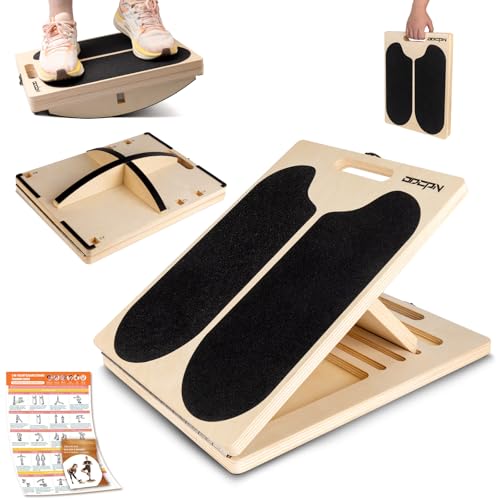
- Six angles from 20° to 45°
- Adds 180° and 360° balance modes
- Folds flat with non-slip surfaces
Best For: Multi-purpose mobility, squat, and balance training
Best Modular Value

- Includes 8.5° and 17° wedges
- Lightweight high-density EPP construction
- Can form a step for cardio and step-ups
Best For: Configurable squat, stretching, and conditioning routines
Best Portable Pick

- Four angles from 20° to 40°
- Folds with carry handle and magnetic closure
- 12-layer wood supports up to 500 pounds
Best For: Portable squat, calf-stretching, and ankle-mobility work
Most Stable One-Piece Pick – Full-Length 15-Degree Squat Wedge
If you want slant boards for squats that provide a broad, unified standing surface, this one-piece wedge is a practical option. Its 15-degree incline supports heel-elevated squats, lunges, calf raises, deadlifts, and mobility work without requiring you to align two separate wedges.
Best For: Lifters who prioritize a wide, stable platform for squats and varied lower-body exercises.
Pros:
- One-piece, 27-by-10-inch design helps maintain consistent foot placement.
- 15-degree incline suits heel-elevated squats, calf stretches, and mobility drills.
- Textured surface and six silicone pads support traction on different surfaces.
- Cross-linked polyethylene construction is pressure-tested to 4,000 pounds and includes an eight-year warranty.
Cons:
- The fixed 15-degree angle offers less adjustment than multi-angle boards.
- Its long, one-piece format may be less compact to store or transport.
Choose this model when stability and a full-length platform matter more than angle adjustability. It is especially useful for users who dislike repositioning separate squat wedges during training.
Best Adjustable Wooden Option – Five-Position Slant Board
For shoppers comparing slant boards for squats with stretching and rehabilitation in mind, this adjustable wooden board offers five positions from 15 to 35 degrees. The side handle, anti-slip treads, and no-assembly setup make it suitable for home workouts, warmups, calf stretching, and recovery routines.
Best For: Users who want multiple incline settings for squats, calf and ankle stretching, and mobility work.
Pros:
- Five adjustable angles—15, 20, 25, 30, and 35 degrees—support different exercises.
- Anti-slip safety treads help provide secure footing.
- Wood construction and a side carry handle support portability.
- Designed for calf flexibility, stretching, squats, and rehabilitation use.
Cons:
- At about nine pounds, it is heavier than many compact wedge-style options.
- The wooden construction may be less convenient for outdoor or wet-surface use.
This is a versatile choice if you want one board to cover both squat preparation and stretching. Its adjustable design is the main advantage over fixed-angle wedges, while the handle makes repositioning easier.
Best Portable Pair – 15-Degree Wooden Squat Wedges
This pair of wooden slant boards for squats is built for users who prefer independent wedges under each foot. The 15-degree angle supports heel elevation and ankle-mobility work, while the textured tops, non-slip bases, carrying bag, and training poster make the kit convenient for home, gym, or travel use.
Best For: Lifters who want a portable two-wedge setup for squats, weightlifting, calf stretches, and ankle mobility.
Pros:
- Pair of wedges allows separate foot positioning for barbell, Smith, and Bulgarian squats.
- 15-degree incline supports deeper squat positioning and ankle-mobility work.
- PVC textured tops and non-slip bases improve grip during training.
- Includes a carrying bag and exercise poster for portability and guided use.
Cons:
- The two-piece design requires users to position and align the wedges separately.
- The fixed angle does not offer the range of settings found on adjustable boards.
Consider this kit if portability and independent foot placement are priorities. It offers a focused squat-wedge setup rather than the larger continuous platform of a one-piece board.
Best High-Angle Adjustability – Steel-Frame Five-Angle Board
If your squat warmups and mobility work call for more than one incline, this steel-frame board provides five settings from 15 to 40 degrees. The 12-by-15.7-inch platform, full-surface traction, foldable design, and 660-pound load capacity make it a flexible option for squats, heel raises, calf stretches, and ankle drills.
Best For: Users who want a sturdy, foldable board with settings suitable for both squat preparation and higher-angle stretching.
Pros:
- Five angle options from 15 to 40 degrees accommodate varied mobility and training needs.
- Reinforced alloy-steel frame supports loads up to 660 pounds.
- Full sand-grain traction layer helps maintain contact with bare feet, socks, or shoes.
- Folds for storage and requires no assembly.
Cons:
- Its single-platform design does not provide independent wedges for each foot.
- The 40-degree setting may be more relevant to stretching than standard heel-elevated squats.
- It has a one-year manufacturer warranty, shorter than some listed alternatives.
This board is a strong fit when angle range and storage convenience are more important than a simple fixed wedge. The steel frame adds structure, while the upper settings expand its use beyond basic squat positioning.
Best Heavy-Duty Heel Elevation – 15° Squat Wedge Block
This pair of compact squat wedges is a practical choice if you want durable slant boards for squats with a fixed, moderate heel elevation. The 15° bevel, full-foot platform, silicone grip surface, and 1,500-pound capacity are suited to barbell, Smith-machine, and Bulgarian squats.
Best For: Lifters who want portable, heavy-duty heel elevation for squats, ankle-mobility work, and calf stretching.
Pros:
- 15° angle supports deep squats and targeted ankle-mobility work.
- High-density ABS construction is rated for up to 1,500 pounds.
- Large 11.8-by-5.9-inch platforms provide full-foot support.
- Textured silicone surfaces, a carrying bag, and training poster are included.
Cons:
- The angle is fixed rather than adjustable.
- The pair weighs about 1 kg and may take more space than compact heel wedges.
Choose this model when stability and load capacity matter more than angle adjustability. Its fixed 15° setup keeps the design simple for repeatable squat positioning, while the broad platforms and grippy surface add confidence during loaded movements.
Best Adjustable Angle – Portable Wooden Slant Board
This adjustable wooden board is one of the more versatile slant boards for squats because it offers five incline settings instead of a single fixed angle. Its folding design, textured PVC surface, and EVA base make it suitable for squat heel elevation, calf stretching, and lower-body mobility work.
Best For: Users who want adjustable intensity for squats, calf stretches, rehabilitation, and mobility routines.
Pros:
- Five settings from 23° to 45° accommodate different flexibility levels.
- 11-ply poplar construction supports up to 460 pounds.
- Textured PVC traction surface and non-slip EVA base help improve grip.
- Weighs about 4.5 pounds, arrives assembled, and folds for transport.
Cons:
- The 460-pound capacity is lower than the other listed options.
- Angle changes require manual placement of the support panel.
This is a strong fit for buyers who want one board for progressive stretching and squat variations. The broad angle range is useful for adjusting difficulty, although users should confirm the board is stable in the selected slot before exercising.
Best Wide Wooden Platform – EVERYMATE Squat Slant Board
The EVERYMATE is a wide hardwood option among slant boards for squats, with a 19.7-inch platform designed to accommodate a broad stance. Its full sandpaper top, non-slip base, and 1,000-pound capacity make it suited to ATG, VMO, weighted-squat, and calf-stretching routines.
Best For: Beginners and experienced athletes who prefer a wide, sturdy platform for squats, stretching, and rehabilitation exercises.
Pros:
- 19.7-inch width provides substantial room for varied stances.
- Hardwood plywood construction supports up to 1,000 pounds.
- Full sandpaper tread, baffle, and base are designed to reduce slipping.
- Preassembled board includes side and rear hand holes for carrying.
Cons:
- The single listed level does not offer adjustable incline settings.
- At about 3.11 kg, it is heavier than the compact wedge-style option.
- The large footprint may be less convenient for small storage areas.
Consider this board if stance width and a solid wood platform are priorities. It supports a broad range of lower-body movements, but its fixed setup and larger size make it better suited to a dedicated home gym or workout space than highly compact travel use.
Most Versatile – 3-in-1 Adjustable Balance Slant Board
If you want slant boards for squats that can also support mobility and balance work, this 3-in-1 wooden model offers plenty of flexibility. It provides six incline settings from 20° to 45°, plus 180° directional and 360° rotational balance modes.
Best For: Users who want one board for calf stretching, squat support, balance training, and recovery work.
Pros:
- Six adjustable angles accommodate gentle through deeper stretching.
- Combines slant-board, 180° balance, and 360° rotation functions.
- Wood construction, non-slip EVA base, and PVC sandpaper foot surface support stable use.
- Folds flat and includes a training poster and instructions.
Cons:
- The extra balance components may be unnecessary if you only need a basic squat wedge.
- Product notes list both a 460-pound capacity and a 300-pound maximum-weight recommendation, so buyers should verify the applicable limit.
This is the most feature-rich option in the group. Its broad angle range is useful for progressing squat and calf-mobility work, while the balance modes add versatility for users who want more than a stationary incline.
Best Modular Value – Stackable EPP Squat Wedge Set
For shoppers seeking slant boards for squats with a modular setup, this EPP wedge set uses separate blocks to create different heel elevations. The included 8.5° and 17° wedges can be paired for squats, stacked for calf stretching, or connected into an aerobic step.
Best For: Lifters and home exercisers who want lightweight, configurable wedges for squats, stretching, calf raises, and step-ups.
Pros:
- Modular blocks offer multiple angle configurations.
- High-density EPP is lightweight, durable, and designed to retain its shape.
- Silicone grip points help improve floor contact and reduce movement.
- Can also function as a calf-raise block, exercise block, or aerobic step.
Cons:
- Separate wedges may not feel as unified as a single hinged slant board.
- The supplied notes do not specify an adjustable angle range beyond the included 8.5° and 17° blocks.
This set is a practical choice when portability and configuration matter more than a fixed wooden platform. Its low-profile blocks can support heel-elevated squats, while the stackable design expands its stretching and conditioning uses.
Best Portable Pick – Foldable Wooden Slant Board
If storage and transport are priorities, this foldable wooden option keeps slant boards for squats convenient for home, office, or gym use. It offers four incline positions—20°, 25°, 30°, and 40°—along with a carry handle, magnetic closure, and non-slip features.
Best For: Users who want a compact, adjustable board for squat practice, ankle mobility, calf stretching, and recovery.
Pros:
- Folds to a compact size and includes an integrated carry handle.
- Four fixed angles make it easy to adjust stretch intensity.
- 12-layer wood construction is designed to support up to 500 pounds.
- Wide non-slip surface and bottom grip pads help provide a planted setup.
Cons:
- It has fewer angle settings than the six-position model in this roundup.
- It is a dedicated slant board without the added balance-training modes of the multi-function option.
This board suits people who are likely to use their equipment more often when it is easy to carry and store. Its four angles cover common mobility and squat-support needs without adding the complexity of balance attachments.
How We Picked the Best Slant Boards for Squats
We focused on the features that matter most during heel-elevated squats and calf-mobility work: stable construction, useful incline angles, weight capacity, surface traction, and ease of storage. The selection includes fixed wedges for straightforward training, adjustable wooden boards for changing the challenge, and compact or multifunctional options for home gyms.
Capacity claims are useful for comparing models, but they should not replace checking the board’s dimensions, base stability, and intended use. A board that supports heavy loads on paper still needs to sit securely on your floor.
Quick Comparison
| Type | Best For | What to Look For |
|---|---|---|
| Fixed wedge | Simple squat setup | Stable base, grippy pads, suitable angle |
| Adjustable board | Squats and mobility progression | Secure angle mechanism and multiple settings |
| Portable or foldable | Small spaces and travel | Low weight, locking parts, durable hinges |
| Balance-board design | Added stability training | Controlled movement and appropriate skill level |
| Stackable set | Several incline options | Secure stacking and easy angle changes |
Key Buying Factors for Slant Boards for Squats
Angle and Adjustability
A moderate incline is a practical starting point for heel-elevated squats, while adjustable models let you change the demand as your mobility and training goals develop. Fixed 15-degree wedges are simple and quick; multi-angle boards offer more flexibility for calf stretching and different squat variations.
Stability and Traction
Look for a broad base, non-slip feet, silicone pads, or a textured standing surface. The board should remain planted when you shift your weight forward or drive upward. Avoid using any model on a slick surface unless its feet are designed for it.
Construction and Capacity
Wooden boards can feel solid and durable, while steel-framed designs may provide additional structural support. Compare the stated capacity with your body weight, barbell load, and expected movement. Wider boards may also feel more secure for larger feet or heavier lifting.
Portability and Storage
For a dedicated home gym, a larger fixed wedge may be ideal. If you train in multiple locations, prioritize handles, folding construction, or a compact footprint. Make sure portability does not compromise locking hardware or base stability.
Who Should Buy Which Slant Boards for Squats?
- Choose a fixed wedge if you want a dependable, low-maintenance platform for heel-elevated squats.
- Choose an adjustable board if you want to vary squat and calf-stretch angles or share the equipment with others.
- Choose a portable or foldable model if storage space is limited or you take your training gear on the road.
- Choose a balance-board option only if you specifically want additional balance work and are comfortable with a less stable surface.
- Choose a stackable set if fine-tuning elevation is more important than having the simplest possible setup.
Whichever of these Slant Boards for Squats you choose, test it first with bodyweight movements, confirm that it stays fixed on your floor, and increase load gradually.