Finding a treadmill that feels comfortable for a taller runner takes more than checking motor power. A sufficiently long running deck, stable frame, useful incline range, and practical weight capacity all affect stride comfort and everyday usability.
We selected 10 home treadmills with features that can suit taller walkers and runners, from heavy-duty full-size machines to foldable models with incline and handlebar support. Use the guide below to match deck design, workout goals, and available space to the right option.
Best 10 Treadmills for Tall People Picks for 2026
Best Heavy-Duty Pick
WELLFIT 400-LB Folding Treadmill

- 400-lb capacity with reinforced frame
- 15% auto incline and 8.8 MPH top speed
- 18-by-43-inch cushioned belt
Best For: Tall or heavier users seeking incline training and a foldable design
Best Guided-Workout Option
NordicTrack T Series Treadmill

- Long 55-inch running deck
- 10 MPH speed and 10% incline
- iFIT guided workouts and auto-adjustments
Best For: Taller users wanting extra deck length and connected coaching
Best Adjustable-Handlebar Pick
CIIHI 400-LB Auto-Incline Treadmill

- Six adjustable handrail heights
- 400-lb capacity with 15% incline
- Folds with wheels for storage
Best For: Multi-user homes needing adaptable handrail height and high capacity
Best Wide-Deck Value

- 20-by-45-inch running belt
- 450-lb capacity and 10 MPH speed
- Quiet 4.0HP brushless motor
Best For: Heavier users wanting a wide, cushioned belt for home workouts
Best for Steep Inclines

- 51-inch handrails for taller users
- Manual incline up to 40%
- 350-lb capacity and quiet 3HP motor
Best For: Tall users focused on steep incline walking and climbing workouts
Best for High Weight Capacity
Cardirun 10% Incline Treadmill

- 400-lb maximum weight recommendation
- 16-by-40-inch running area
- App, voice, pulse, and preset workout features
Best For: Users prioritizing capacity and connected home-workout features
Best for Automatic Incline
WELLFIT 12% Incline Walking Pad

- Automatic 0%–12% incline adjustment
- Extended dual handrails and 375-lb capacity
- 5.5-inch folded height with app control
Best For: Tall walkers and joggers wanting supported, compact incline training
Best All-Around Choice
FOUSAE 5-in-1 Incline Treadmill

- 0.6–7.5 MPH speed range with 10% incline
- 400-pound capacity and cushioned 40 x 16-inch deck
- App compatibility, 12 HIIT programs, and folding handle
Best For: Versatile home workouts and users prioritizing capacity
Best for Easy Control

- Handlebar, remote, app, and voice controls
- 36 x 16-inch cushioned belt with automatic alignment
- 6.2 MPH maximum, 10% manual incline, and 350-pound capacity
Best For: Walking, light jogging, and compact home-office setups
Best Incline Value
LONTEK 15% Incline Walking Pad
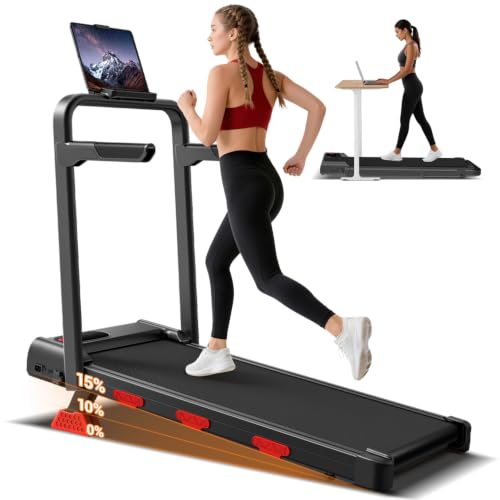
- Flat, 10%, and 15% manually selectable incline levels
- Quiet 3.0HP brushless motor with speeds up to 6.2 MPH
- 350-pound capacity, handle, and removable device holder
Best For: Incline walking in compact spaces
Best Heavy-Duty Pick – WELLFIT 400-LB Folding Treadmill
For shoppers comparing treadmills for tall people, the WELLFIT 400-LB model stands out for its heavy-duty frame, 18-by-43-inch belt, and 4.0HP motor. It reaches 8.8 MPH, offers up to 15% auto incline, and folds for easier storage.
Best For: Tall or heavier users who want incline training, a stable frame, and a folding home treadmill.
Pros:
- 400-pound maximum user capacity and reinforced alloy-steel frame.
- 15-level auto incline and speeds from 0.6 to 8.8 MPH.
- Multi-layer belt, under-45dB operation, Bluetooth, and voice/app control.
Cons:
- The 43-inch deck may still feel short for users with especially long running strides.
- Its heavy-duty construction weighs 92.6 pounds.
This is a practical choice when stability, capacity, and incline matter more than top running speed. Tall runners should compare the 43-inch deck with their stride length before buying.
Best Guided-Workout Option – NordicTrack T Series Treadmill
The NordicTrack T Series is a strong option among treadmills for tall people because its 55-inch deck is longer than the other models here. It supports speeds up to 10 MPH, has a 0-10% incline range, and includes KeyFlex cushioning for more comfortable walking or running.
Best For: Taller users who prioritize a longer deck and interactive iFIT training at home.
Pros:
- 55-inch deck provides more stride room than the other listed models.
- 10 MPH top speed and 0-10% incline support running and hill workouts.
- iFIT can provide guided workouts, automatic adjustments, and app syncing with a membership.
Cons:
- The maximum weight recommendation is 300 pounds.
- Several smart features require an iFIT Train Membership.
- The listed display is a compact 5-inch LCD.
Its longer running surface makes this the most stride-friendly choice in the roundup for taller runners. Consider it especially if structured coaching and connected workouts are more important than maximum user capacity.
Best Adjustable-Handlebar Pick – CIIHI 400-LB Auto-Incline Treadmill
The CIIHI earns consideration among treadmills for tall people with six adjustable handrail heights ranging from 26.5 to 39.5 inches. Its 400-pound capacity, 15% auto incline, and app and voice controls make it a flexible option for shared household use.
Best For: Families or taller users who need adjustable handrails, high capacity, and compact storage.
Pros:
- Handrails adjust through six height settings for different users.
- 400-pound capacity, 15% auto incline, and speeds up to 8.7 MPH.
- Folding design, front wheels, Bluetooth, app compatibility, and voice control.
Cons:
- The 43.31-inch deck may not provide enough length for every tall runner.
- The 16.93-inch belt is narrower than the WELLFIT 450 model.
- It includes five preset programs.
The adjustable handrail is its clearest advantage for taller users and multi-user homes. Because the deck is relatively compact, it is better suited to walking, jogging, and moderate running than long-stride training.
Best Wide-Deck Value – WELLFIT 450-LB Treadmill
For tall users who also want extra side-to-side room, this WELLFIT model combines a 45-by-20-inch belt with a 450-pound capacity. It reaches 10 MPH, uses a 4.0HP brushless motor, and includes cushioning, pulse sensors, Bluetooth, and a large LED display.
Best For: Heavier users and runners who want the widest belt in this roundup for home or apartment workouts.
Pros:
- Extra-wide 20-inch belt and 450-pound maximum capacity.
- 4.0HP brushless motor, 10 MPH top speed, and quiet operation under 45dB.
- Five-layer belt, eight shock absorbers, pulse sensors, Bluetooth, and 12 programs.
Cons:
- The 45-inch deck is shorter than the NordicTrack’s 55-inch deck.
- Incline adjustment is manual and limited to 5%.
- The listed warranty is two years.
This model offers the most belt width and highest capacity among these options, which can improve comfort and confidence for larger users. Tall runners should still verify that its 45-inch length matches their natural stride.
Best for Steep Inclines – CURSOR 40% Incline Treadmill
For tall users comparing treadmills for tall people, the CURSOR stands out with 51-inch handrails and a 38.6-by-15.4-inch walking belt. Its standout feature is the five-position manual incline, reaching 40% for hill- and stair-climbing-style workouts.
Best For: Taller users who prioritize steep incline training, extended hand support, and a high weight capacity.
Pros:
- 51-inch dual handrails are designed to support a more upright posture for users 5’11” and taller.
- Five manual incline settings range from 0% to 40%, with the deck reaching 15 inches at maximum incline.
- 350-pound capacity, reinforced base, anti-shake pads, and multilayer cushioning support stable workouts.
- Quiet 3HP brushless motor operates below 45 dB and supports speeds up to 7.5 mph.
Cons:
- Incline adjustment is manual rather than automatic.
- The walking belt is narrower than some full-size running treadmills.
- Its maximum speed is better suited to walking, incline work, jogging, and light running than fast running.
The CURSOR is a specialized choice for tall users who want substantial incline capability and longer handrails in a foldable home treadmill. Its compact folded profile adds storage convenience, while the manual adjustments keep the design straightforward.
Best for High Weight Capacity – Cardirun 10% Incline Treadmill
The Cardirun is a practical option among treadmills for tall people who want extra capacity and a roomy walking surface. It combines a 16-by-40-inch belt with a 400-pound limit, three manual incline levels, and speeds up to 7.6 mph.
Best For: Home users who want a higher weight capacity, basic incline training, and app-connected workout controls.
Pros:
- 400-pound maximum weight recommendation is the highest among these options.
- Three manual incline settings—0%, 3%, and 10%—add workout variety.
- 7-layer belt, eight shock absorbers, and six soft cushions are designed to improve step comfort.
- Includes app, voice, speaker, preset-program, pulse-monitoring, and Apple Health/Kinomap features.
Cons:
- The 40-inch belt length may feel limiting for taller users with a long running stride.
- Incline changes require manual adjustment.
- The supplied notes do not specify extended handrail height.
The Cardirun makes the most sense when user weight capacity and connected features matter more than maximum incline or a particularly long deck. Its hydraulic folding assist and mostly assembled delivery also help simplify home setup.
Best for Automatic Incline – WELLFIT 12% Incline Walking Pad
For shoppers seeking treadmills for tall people with easier incline control, the WELLFIT pairs extended dual handrails with automatic 0%–12% incline adjustment. Its 40-by-16-inch belt, 375-pound capacity, and 0.6–7.6 mph range cover walking, jogging, and moderate running.
Best For: Taller users who want automatic incline changes, added handrail support, and compact storage.
Pros:
- Automatic incline adjusts from 0% to 12% without stopping for manual changes.
- Extended dual handrails provide additional balance and support.
- 375-pound capacity, 3.5HP brushless motor, and operation below 40 dB suit shared spaces.
- Folded height of 5.5 inches, transport wheels, app control, and auto-alignment belt support convenient storage and use.
Cons:
- The 40-inch belt may not provide as much stride room as a full-size treadmill.
- A 12% maximum incline is less steep than the CURSOR’s 40% setting.
- The supplied notes do not state the exact handrail height.
The WELLFIT is a balanced fit for taller walkers and joggers who value support, quiet operation, and automatic incline control in a space-saving frame. It offers more convenience than a manual-incline model while remaining easy to move and store.
Best All-Around Choice – FOUSAE 5-in-1 Incline Treadmill
For shoppers comparing treadmills for tall people, the FOUSAE stands out for its broad feature set, 400-pound capacity, and cushioned 40 x 16-inch running deck. It supports walking, jogging, and running at speeds up to 7.5 MPH, while the folding handle lets it work as either a conventional treadmill or an under-desk walking pad.
Best For: Home users who want versatile training modes, incline capability, and a higher weight capacity.
Pros:
- Runs from 0.6 to 7.5 MPH with a 10% incline.
- 400-pound maximum weight recommendation.
- Includes app compatibility, 12 HIIT programs, remote control, and countdown modes.
- Seven-layer cushioned deck with shock-absorbing columns and strips.
Cons:
- The 40-inch deck may still feel limited for some taller runners with a long stride.
- Its feature-rich design may be more than casual walkers need.
The FOUSAE is the strongest match here for users who want more than basic walking. Its speed range, incline, programming, and sturdy capacity make it the most flexible option, although taller users should consider whether the deck length suits their stride.
Best for Easy Control – WELLFIT Folding Treadmill
The WELLFIT is a practical option among treadmills for tall people who primarily walk or lightly jog and want simple controls. Its handlebar buttons, remote, app, and voice-control options reduce the need to bend down, while the folding frame and transport wheels help it fit into smaller spaces.
Best For: Walkers, beginners, and home-office users who value convenient controls and compact storage.
Pros:
- Handlebar controls provide quick access to start, stop, and speed adjustments.
- Five-layer cushioned 36 x 16-inch belt is designed to reduce impact.
- Supports up to 6.2 MPH, a 10% manual incline, and up to 350 pounds.
- Automatically centers the belt and works with multiple fitness apps.
Cons:
- The 36-inch deck is relatively short for taller users or longer strides.
- Its 6.2 MPH maximum is better suited to walking and light jogging than fast running.
WELLFIT focuses on convenience rather than high-speed training. The self-aligning belt, fingertip controls, and compact folding design are useful for daily walking, but taller runners should carefully assess the shorter deck length before buying.
Best Incline Value – LONTEK 15% Incline Walking Pad
For shoppers seeking treadmills for tall people with hill-training options, the LONTEK offers three manually selectable levels: flat, 10%, and 15%. Its handle, phone holder, compact profile, and 350-pound capacity make it useful for home walking workouts, while the 37.4-inch belt is best suited to walking and light jogging.
Best For: Users who want steep incline walking and a slim treadmill for apartments or home offices.
Pros:
- Provides flat, 10%, and 15% incline positions without complicated electronic settings.
- Quiet 3.0HP brushless motor operates below 45 dB.
- Supports up to 350 pounds and speeds from 0.6 to 6.2 MPH.
- Includes a removable phone or tablet holder and compact storage design.
Cons:
- Manual incline changes require physically repositioning the unit.
- The 37.4 x 15-inch belt is narrow and short for taller users with long strides.
- It is geared toward walking and light jogging rather than faster running.
The LONTEK is compelling if incline walking is the priority. Its 15% setting adds meaningful hill-workout flexibility, but the narrow, short belt means taller shoppers should treat it as a walking pad first rather than a full-size running treadmill.
How We Picked the Best Treadmills for Tall People
We focused on specifications that matter most when a treadmill needs to accommodate longer strides and frequent home use. Our comparison considers advertised running-surface dimensions, motor and weight-capacity claims, frame stability, incline capability, speed range, folding design, controls, and convenience features such as app compatibility. Because manufacturers may list dimensions differently, confirm the usable belt length and width before buying, especially if you plan to run rather than walk.
We also included a mix of heavy-duty treadmills, compact walking-focused machines, and incline models. That makes the list useful for different budgets, room sizes, and training styles without treating every treadmill as interchangeable.
Quick Comparison
| Best For | Look For | Models to Consider |
|---|---|---|
| Longer running strides | Extended deck and stable frame | NordicTrack T Series, CURSOR 40% Incline |
| Higher user weights | Advertised 400-pound capacity and reinforced construction | WELLFIT 400+LB, CIIHI, Cardirun |
| Incline workouts | Automatic incline with a broad range | CIIHI, CURSOR, LONTEK |
| Small spaces | Folding frame or walking-pad format | WELLFIT Walking Pad, WELLFIT Folding, LONTEK |
| Connected training | App compatibility and guided workout support | NordicTrack T Series, 5-in-1 App-Compatible model |
Key Buying Factors for Treadmills for Tall People
Deck Length and Width
Deck length is the first specification to check. Taller users and runners with a long stride generally need more usable belt length to avoid shortening their gait or stepping near the rear edge. A wider belt can also improve confidence during faster sessions. Walking pads may be convenient, but their shorter decks are usually better suited to walking and light jogging than sustained running.
Motor, Capacity, and Stability
A treadmill should comfortably support your body weight, with some margin for movement and long-term durability. Heavy-duty frames and higher advertised capacities can reduce vibration, but they may also increase the machine’s size and weight. Look for a rigid frame, secure handrails, and a belt that tracks smoothly.
Incline, Speed, and Controls
Automatic incline adds workout variety and can increase effort without requiring a faster pace. A 10% to 15% incline suits many home training plans, while steeper systems are more specialized. Check whether incline and speed changes are easy to reach while moving, and verify the maximum speed if running performance matters.
Footprint and Maintenance
Measure the treadmill’s assembled and folded dimensions, then leave clearance around it for safe access and ventilation. Folding designs save floor space but can be heavier to move. Regular belt lubrication, cleaning, and alignment checks are essential for smooth operation.
Who Should Buy Which Treadmills for Tall People?
Choose a full-size heavy-duty model if you are tall, run regularly, or want the most stable platform. Choose an incline-focused treadmill if hill workouts are central to your routine. Choose a folding treadmill when storage is a priority but you still need occasional jogging capability. Choose a walking pad for desk walking, low-impact movement, and compact storage; confirm that its deck suits your stride before attempting faster workouts. Finally, connected or app-compatible models are best for buyers who value guided training and progress tracking.