A compact home gym can quickly become cluttered when dumbbells, kettlebells, and plates are left on the floor. The right rack keeps equipment accessible while using less wall and floor space.
This roundup compares 10 weight storage racks for small spaces, with options for different weight loads, layouts, and storage needs.
Best 10 Weight Storage Racks for Small Spaces Picks for 2026
Compact Steel Organizer

- Shallow 8.25-inch depth
- 10 rack positions for dumbbells
- 400-pound maximum capacity
Best For: Organizing dumbbells in a compact home gym
Adjustable Three-Tier Storage

- Shelf widths adjust from 2.76 to 6.70 inches
- 390-pound total capacity
- Reinforced powder-coated metal
Best For: Flexible dumbbell storage for home gyms
Corner-Friendly A-Frame

- Stores up to four dumbbell pairs
- Silicone-lined protective cradles
- Built-in handle for moving
Best For: Light dumbbells in compact workout corners
Mobile Multi-Equipment Storage

- Stores weights and fitness accessories
- 350-pound maximum capacity
- Four wheels with two locking brakes
Best For: Mobile organization of mixed home-gym equipment
Compact Adjustable Pick

- Compact 20-inch-wide footprint
- Adjustable 2"–6" spacing
- Supports up to 250 pounds
Best For: Small home gyms with moderate weight collections
All-in-One Organizer
Rolling 3-Tier Gym Storage Rack

- Stores weights and workout accessories
- Adjustable three-tier dumbbell zones
- Six wheels, including three locking wheels
Best For: Multi-purpose home gyms needing mobile organization
High-Capacity Pick

- Three tiers in a 20-inch-wide frame
- Supports up to 500 pounds
- Adjustable 2"–6" storage spacing
Best For: Small spaces holding a heavier weight collection
Compact A-Frame Organizer

- 12-by-12-inch footprint for tight areas
- Stores up to five pairs of compatible dumbbells
- Handle, leveling pads, and non-slip supports
Best For: Small home gyms with lighter dumbbell sets
Heavy-Duty Adjustable Organizer

- 450-pound maximum capacity
- Adjustable spacing from about 2 to 6.7 inches
- Leveling feet and durable powder-coated metal
Best For: Mixed home-gym equipment needing flexible storage
Maximum-Capacity Compact Rack
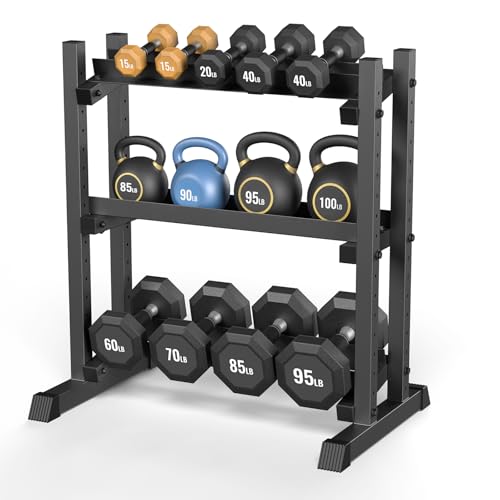
- Supports up to 1,100 pounds
- Adjusts in height, angle, and width
- Angled shelves and rubber base pads
Best For: Heavy mixed equipment in a larger home-gym area
Compact Steel Organizer – Marcy Weight Storage Rack
If you need weight storage racks for small spaces, the Marcy DBR-56 offers a compact way to organize dumbbells while keeping them accessible. Its rectangular frame measures 26.75 inches wide, 8.25 inches deep, and 20.5 inches high.
Best For: Home gym users who primarily need organized dumbbell storage in a narrow footprint.
Pros:
- Compact 8.25-inch-deep design fits into tighter workout areas.
- Multiple trays and 10 rack positions accommodate different dumbbell sizes.
- Commercial-grade alloy steel supports up to 400 pounds.
- Powder-coated finish helps resist scratches and scuffs.
Cons:
- The supplied details focus on dumbbell storage rather than dedicated kettlebell or plate storage.
- At 26.75 inches wide, it may still require a defined section of floor space.
This is a straightforward choice when dumbbell organization and a shallow profile matter most. Its high stated capacity adds flexibility for a growing home gym.
Adjustable Three-Tier Storage – 3 Tier Dumbbell Rack
For shoppers comparing weight storage racks for small spaces, this three-tier model combines adjustable shelf widths with a compact tiered frame. Each shelf adjusts from 2.76 to 6.70 inches, helping accommodate different dumbbell sizes and select other equipment.
Best For: Home gym users who want adjustable shelves and substantial capacity in a vertical three-tier layout.
Pros:
- Adjustable horizontal bars provide a customizable fit for different weights.
- Each shelf supports up to 130 pounds, with a 390-pound total capacity.
- Powder-coated reinforced metal construction is designed for regular use.
- Includes hardware and tools for assembly.
Cons:
- Its 31.5-inch width and height may be larger than expected for very tight spaces.
- Dumbbells are not included.
- The notes do not specify wheels for easy relocation.
This rack is a practical middle ground between capacity and organization. The adjustable shelves are especially useful if your weight collection includes varied dumbbell sizes.
Corner-Friendly A-Frame – Four-Tier Dumbbell Tower
4-Tier Dumbbell Rack Stand Only Weight Holder Home Gym Storage Weight Tree (No Dumbbells)
Check Price On AmazonThis A-frame tower is a space-conscious option among weight storage racks for small spaces, with four tiers intended for pairs of lighter dumbbells. Its triangular structure and built-in handle make it easy to position in a corner or move when needed.
Best For: Small home workout areas using up to four pairs of dumbbells weighing approximately 3 to 20 pounds.
Pros:
- Four-tier layout stores up to four pairs of dumbbells.
- A-frame construction is designed for balance and resistance to tipping.
- Silicone-lined cradles help protect dumbbells and reduce noise.
- Built-in handle and included tools support convenient relocation and assembly.
Cons:
- Its stated capacity is limited to 100 pounds.
- Storage is intended for smaller dumbbells, not a broad range of heavy weights.
- Dumbbells are not included.
Choose this model when a small, movable stand is more important than maximum capacity. The padded cradles are a useful touch for rubber hex dumbbells and noise-sensitive spaces.
Mobile Multi-Equipment Storage – PLKOW Rack with Wheels
If your small workout area needs more than dumbbell storage, the PLKOW rack combines tiered shelves, a basket, hooks, and wheels. It can organize dumbbells, kettlebells, balls, yoga accessories, resistance bands, and other equipment in one rolling unit.
Best For: Home gyms that need high-capacity, movable storage for mixed workout equipment.
Pros:
- Multiple storage areas hold weights, balls, yoga blocks, mats, foam rollers, and bands.
- Steel construction with an anti-rust powder coating supports up to 350 pounds.
- Four wheels make the rack movable, while two wheels lock for stability.
- Hooks and a side basket help keep smaller accessories organized.
Cons:
- At 41.5 inches long and 37 inches high, it needs more floor and vertical space than compact dumbbell-only racks.
- Its 15.8-inch depth may be too large for especially narrow spaces.
- The notes do not specify the weight capacity of individual shelves.
This is the most versatile option in the group, but its larger dimensions trade some compactness for much broader equipment storage. The locking wheels are useful when your workout layout changes regularly.
Compact Adjustable Pick – 2-Tier Adjustable Weight Rack
If you need weight storage racks for small spaces, this compact two-tier stand keeps dumbbells, kettlebells, and plates organized without taking up much floor area. Its 20-inch width and adjustable bar spacing make it practical for a streamlined home gym.
Best For: Small home gyms needing compact, adjustable weight storage.
Pros:
- Compact 20″ W x 10″ D x 17″ H footprint.
- Four-level spacing adjusts from about 2″ to 6″.
- Heavy-duty steel frame supports up to 250 pounds.
- Rotatable leveling feet improve stability on uneven floors.
Cons:
- Rack only; weights and other accessories are not included.
- Two tiers provide less capacity than a three-tier organizer.
This is a sensible choice when floor space is limited and you want straightforward storage for a moderate collection of weights. The compact footprint and leveling feet are especially useful in smaller or uneven workout areas.
All-in-One Organizer – Rolling 3-Tier Gym Storage Rack
For shoppers comparing weight storage racks for small spaces, this rolling organizer combines three adjustable dumbbell tiers with storage for mats, balls, kettlebells, and accessories. Its wheels make it easier to reposition when your workout area needs to do double duty.
Best For: Home gyms that need mobile, multi-purpose storage for weights and accessories.
Pros:
- Combines three dumbbell tiers with yoga-mat storage, a ball shelf, hooks, and a kettlebell area.
- Adjustable storage zones accommodate different dumbbell sizes.
- Six wheels provide mobility, with three locking wheels for stability.
- Metal construction supports up to 65 pounds per dumbbell tier and 45 pounds on the mesh section.
Cons:
- At 33.31″ W x 11.81″ D x 31.85″ H, it needs more width than the compact rack-only options.
- Assembly is required.
This model is best when organization goes beyond weights. The wider frame uses more floor space, but the accessory storage and rolling design can reduce clutter and make a shared workout room easier to manage.
High-Capacity Pick – 3-Tier Adjustable Weight Rack
This three-tier rack is a strong option among weight storage racks for small spaces when you need substantial capacity in a narrow footprint. It measures 20 inches wide and 9.8 inches deep while offering adjustable spacing for dumbbells, kettlebells, and plates.
Best For: Compact home gyms storing a larger, heavier collection of weights.
Pros:
- Three tiers provide about 60 inches of total storage length.
- Four-level spacing adjusts from about 2″ to 6″.
- Reinforced H-frame supports up to 500 pounds.
- Leveling feet help keep the rack steady on uneven floors.
Cons:
- Rack only; it does not include weights or accessory storage.
- Its 31-inch height may be less convenient for users who prefer lower storage.
Choose this rack when vertical organization and load capacity matter more than having built-in accessory compartments. Its narrow depth helps conserve floor space, while the three-tier layout accommodates more equipment than a two-tier stand.
Compact A-Frame Organizer – 5-Tier Dumbbell Rack
If you need weight storage racks for small spaces, the AmazeFan A-frame stand is a compact option for organizing several lighter dumbbell sets. Its 12-by-12-inch footprint and carrying handle make it well suited to corners, garages, offices, or home gyms where equipment needs to stay easy to move.
Best For: Home users storing up to five pairs of 5- to 25-pound dumbbells in a compact footprint.
Pros:
- Five-tier design can hold up to five pairs of compatible dumbbells and up to 200 pounds.
- Compact 12″ D x 12″ W x 28″ H A-frame design fits tight spaces.
- All-metal construction, leveling corner pads, and non-slip supports improve stability.
- Built-in handle and 8.8-pound frame make repositioning easier.
Cons:
- Dumbbells are not included.
- Compatibility varies by dumbbell style and handle diameter, so measurements are important.
- The supplied details list a 25-pound maximum weight capacity, which may limit heavier setups.
This rack emphasizes a small footprint and portability over oversized capacity. It is a practical choice for keeping a modest dumbbell collection off the floor, provided your weights fit the tier spacing and stay within the stated limits.
Heavy-Duty Adjustable Organizer – 3-Tier 450-LB Rack
Among weight storage racks for small spaces, this adjustable three-tier stand offers a useful balance of capacity and footprint. Its horizontal bars adjust from about 2 to 6.7 inches, allowing the rack to accommodate dumbbells, kettlebells, and weight plates while keeping a compact workout area organized.
Best For: Home gyms needing high-capacity, adjustable storage in a roughly 31.5-inch-wide footprint.
Pros:
- Rated to hold up to 450 pounds.
- Adjustable bar spacing helps organize different equipment types.
- H-structure and powder-coated metal construction provide a durable frame.
- Rotatable leveling feet help stabilize the rack on uneven floors.
Cons:
- Dumbbells and other weights are not included.
- Its approximately 31.5-inch width may be too large for very narrow corners.
- Storage compatibility still depends on the size and shape of your equipment.
This model is better suited to a growing collection than a compact dumbbell-only stand. The adjustable bars and 450-pound rating add flexibility, while the leveling feet help keep a heavily loaded rack steady.
Maximum-Capacity Compact Rack – Adjustable 3-Tier Stand
For weight storage racks for small spaces that must handle a substantial collection, this adjustable TOPIRON stand combines a three-tier layout with height, angle, and width adjustments. Its angled shelves and stated 4.5-cubic-foot footprint are designed to keep dumbbells, kettlebells, and accessories organized while preserving access in a home gym.
Best For: Users with heavy or mixed equipment who need highly adjustable, high-capacity storage.
Pros:
- Heavy-gauge steel and welded H-frame construction support up to 1,100 pounds.
- Height, angle, and width adjustments accommodate different equipment sizes.
- Angled shelves and non-slip rubber pads support easier access and stable placement.
- Powder-coated surface resists scratches and sweat.
Cons:
- Dumbbells and kettlebells are not included.
- The listed dimensions—34.65″ D x 18.7″ W x 36.54″ H—may require more room than narrower racks.
- Assembly requires careful tightening after all parts are installed.
This is the most capable option here for a substantial home-gym load, but its dimensions should be checked carefully before purchase. The broad adjustment range makes it versatile, while the angled shelves can make heavier equipment easier to reach.
How We Picked the Best Weight Storage Racks for Small Spaces
We focused on racks designed to organize free weights without requiring a large dedicated gym room. The selection includes two- and three-tier stands, taller dumbbell towers, A-frame designs, adjustable racks, and models with wheels, hooks, or accessory storage. We also considered listed weight capacity, footprint, construction, portability, and how easily each design can fit beside a wall or in a corner.
Because these products vary in dimensions and intended loads, confirm the manufacturer’s measurements and capacity before ordering. A rack should be evaluated based on the actual shape and size of your equipment, not just its tier count.
Quick Comparison
- Smallest footprint: Two-tier and compact three-tier racks are usually easiest to place in apartments, bedrooms, or narrow workout areas.
- Most vertical storage: Four- and five-tier towers make better use of height when floor space is limited.
- Best for flexible layouts: Adjustable racks can accommodate different dumbbell or kettlebell sizes and spacing requirements.
- Best for moving equipment: Wheeled models are useful when the workout area doubles as living space, provided the wheels lock securely.
- Best for heavier collections: Heavy-duty racks with clearly stated high capacities are preferable for extensive free-weight sets.
Key Buying Factors for Weight Storage Racks for Small Spaces
Footprint and Clearance
Measure the available floor area, including room to walk around the rack and lift weights safely. A narrow rack may fit better than a wide horizontal stand, while a taller model requires adequate ceiling clearance and a stable, level surface.
Capacity and Weight Distribution
Check both the total capacity and the recommended load for each tier or hook. Place heavier weights on lower levels whenever possible to improve stability. Never assume a rack’s capacity includes unusually large plates, oversized dumbbells, or unevenly distributed loads.
Compatibility with Your Equipment
Tier width, shelf depth, handle clearance, and spacing matter. Hex dumbbells, round dumbbells, kettlebells, and weight plates may require different supports. Measure your largest items before choosing a compact rack.
Stability, Assembly, and Mobility
Look for a broad enough base, solid frame construction, protective feet, and secure hardware. Wheels and handles improve portability, but they should not make the rack wobble during loading. If the rack will remain in one place, a fixed design may offer better stability.
Who Should Buy Which Weight Storage Racks for Small Spaces?
Apartment and bedroom gym users should start with a compact two- or three-tier rack that keeps the footprint low. Users with growing dumbbell collections may prefer an adjustable or taller multi-tier tower to avoid replacing the rack later. Mixed-equipment owners should consider models with hooks, yoga-mat storage, or additional accessory space. High-volume strength trainers should prioritize a clearly documented heavy-duty capacity and a stable steel frame over the smallest possible footprint. Finally, shared-space users may benefit from a wheeled rack that can be moved after training, as long as it locks firmly and remains balanced when loaded.