KOOTLEE 20-Head Massage Gun review: this handheld massager is built for serious recovery and everyday tension relief.
It stands out for its 20-head design, quiet operation, and unusually wide adjustment range.
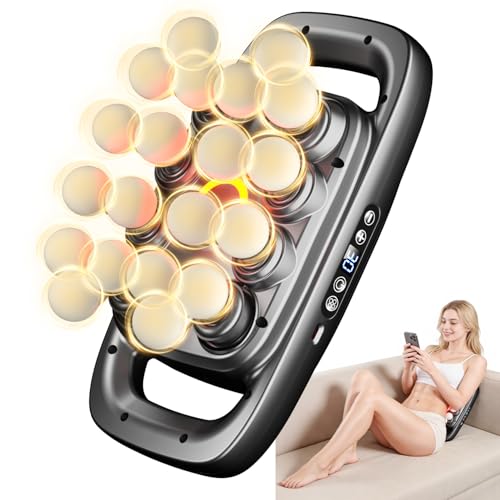
KOOTLEE Massage Gun Review Summary
If you want a deep tissue massage gun that feels more substantial than a basic single-head model, the KOOTLEE 20-Head Massage Gun is aimed at exactly that kind of buyer.
It is especially appealing for people who want broad muscle coverage on the back, neck, shoulders, legs, and waist, plus enough control to dial the intensity up or down without guessing.
From a buyer’s perspective, the biggest strengths are its 20-head design, 3 modes, 30 intensity levels, and a claimed 25mm penetration depth that suggest real percussion power rather than light surface vibration.
Add in Type-C charging, quiet operation, and basic protection features, and you get a massage gun that looks well thought out for home recovery, office use, and post-workout routines.
The tradeoff is size and weight.
At 3.59 pounds, it is not the lightest handheld massager, so users who want something ultra-portable or effortless to hold for long sessions may prefer a smaller model.
Still, if your priority is stronger multi-area relief and better control, this is a compelling option.
Scorecard
| Category | Score | Notes |
|---|---|---|
| Deep Tissue Relief | 8.0 | The 20-head design, strong motor output, 25mm penetration, and high-force percussion are aimed at deeper muscle release rather than light relaxation. |
| Adjustability | 9.0 | It offers 3 modes and 30 intensity levels, giving users a wide range of massage strength and targeting options. |
| Noise Level | 8.0 | Triple noise-reduction measures and low-decibel operation make it workable in home, office, or gym settings. |
| Battery and Charging | 7.0 | The 2000mAh battery and Type-C fast charging help portability, though runtime is better for moderate use than all-day sessions. |
| Comfort and Handling | 8.0 | The anti-slip, vibration-damping handle and ergonomic grip reduce hand fatigue during longer sessions. |
| Safety Features | 8.0 | Charging protection, overload protection, and automatic shutdown help prevent overuse and protect the device. |
| Portability | 7.0 | It is portable in concept, but the unit is relatively hefty for frequent travel or one-handed use. |
Bottom line: the KOOTLEE 20-Head Massage Gun makes the most sense for buyers who want adjustable deep tissue relief with broader contact coverage than a standard massage gun.
If you want simple, lightweight relaxation, skip it.
If you want a more capable recovery tool, it deserves a close look.
Key Features and Specifications of KOOTLEE Massage Gun
Here is the spec profile that matters most when comparing the KOOTLEE 20-Head Massage Gun with other handheld massagers:
| Specification | Details |
|---|---|
| Brand / Model | KOOTLEE / K003 |
| Product Type | Handheld massager |
| Massage Heads | 20 |
| Modes | 3 |
| Intensity Levels | 30 |
| Penetration Depth | 25mm claimed |
| Force | 58kg claimed |
| Peak Speed | Up to 32,800 RPM claimed |
| Battery | 2000mAh |
| Charging | Type-C fast charging |
| Runtime | Up to 2 hours claimed |
| Noise | 30–40 dB claimed |
| Auto Shutoff | 15 minutes |
| Dimensions | 11.02 x 7.87 x 3.94 inches |
| Weight | 3.59 pounds |
| Safety Features | Charging protection, overload protection, automatic shutdown |
| Design Features | Anti-slip, vibration-damping handle; ring-shaped grips; LED intelligent digital display |
Those numbers tell an important story.
The multi-head layout is not a gimmick if you want broader contact over larger muscle groups, and the 30 intensity levels make this a more flexible device than many basic recovery tools.
The 25mm claimed depth also suggests that KOOTLEE is targeting users who want stronger percussion rather than a gentle massage experience.
The 2000mAh battery and Type-C charging are practical, modern choices.
A 15-minute auto power-off is also smart from a safety and motor-protection standpoint, even if it means long sessions need to be restarted manually.
Pros and Cons of KOOTLEE Massage Gun
Every handheld massager has tradeoffs, and the KOOTLEE 20-Head Massage Gun pros and cons are especially important because its design is more specialized than a standard massage gun.
Pros
- Wide coverage from the 20-head design, which is useful on larger muscle groups.
- Excellent adjustability with 3 modes and 30 intensity levels.
- Strong deep tissue focus for post-workout recovery and stubborn tightness.
- Quiet operation that is better suited to shared spaces than many power-focused massage tools.
- Comfortable to hold thanks to the anti-slip, vibration-damping handle.
- Safety protections add confidence for regular use.
- Type-C charging is convenient and easier to manage than older charging setups.
Cons
- Heavier and bulkier than compact massage guns.
- May feel like too much device for users who only want mild relaxation.
- Runtime is not class-leading for all-day, repeated use.
- 15-minute auto shutoff can interrupt longer therapy-style sessions.
- Many settings may be overkill if you prefer a simple one-button massager.
For many shoppers, the key question is not whether it works, but whether its bulk and intensity are a fair trade for the extra coverage and power.
If that sounds right, it is a strong fit.
Who Should Buy KOOTLEE Massage Gun?
The KOOTLEE Massage Gun is best for people who want more than a basic relaxation wand.
It fits buyers who need full-body muscle relief after workouts, long workdays, or repetitive physical strain, especially if they frequently feel tightness in the back, shoulders, legs, or waist.
- Good fit for athletes and active users who want recovery support after training.
- Good fit for office workers dealing with upper-back and neck tension.
- Good fit for people who want multiple intensity choices rather than one fixed massage strength.
- Good fit for buyers who prefer a quieter device for home or office use.
- Good fit for gift shoppers looking for a practical recovery tool.
Who should skip it?
If you want a lightweight travel massager, dislike heavier handheld devices, or only need mild soothing vibration, this is probably more product than you need.
Sensitive users should also start low because the device is marketed for deep tissue work and may feel intense on tender areas.
How the 20-Head Design Feels on Different Muscle Groups
The biggest design choice here is the 20-head massage layout.
On paper, that means broader contact and more distributed pressure than a narrow single-head percussion gun.
In practice, that usually changes both the feel and the target use cases.
On large muscle groups like the thighs, calves, glutes, and lower back, the wide contact pattern can feel efficient because it covers more area at once.
That makes it attractive for post-workout recovery or for loosening stiffness after a long day on your feet.
On smaller or more delicate areas like the neck or around the shoulder blades, the same design can feel a bit more assertive.
That is not necessarily bad, but it does mean this is not the kind of massager you buy for feather-light relaxation.
The best approach is to begin at a lower intensity and let the device do the work gradually.
This is where the KOOTLEE stands apart from simpler alternatives.
A standard massage gun often uses a single percussive head to focus pressure into one point.
KOOTLEE’s multi-head approach spreads the sensation differently, which may appeal to users who want a broader, more encompassing massage feel rather than pinpoint percussion.
Noise, Vibration, and Everyday Use
Noise matters more than many buyers expect.
A massage gun that is too loud tends to get used less, especially in a shared home, office break room, or gym environment.
KOOTLEE claims 30–40 dB operation, supported by triple noise-reduction measures that combine noise reduction, shock absorption, and sound insulation.
That kind of approach is smart.
The device is not just trying to be quiet through motor tuning alone; it also tries to reduce vibration transfer, which can make a handheld massager feel more controlled in the hand.
The result should be a more comfortable experience for people who use it regularly.
From a practical standpoint, this matters if you want to use the device while watching TV, unwinding in a bedroom, or doing recovery work after the gym without drawing too much attention.
It is still a percussion massager, so some mechanical sound is inevitable, but the design direction is clearly toward more pleasant everyday use.
Battery Life and Charging Experience
The battery story is straightforward: a 2000mAh battery with Type-C fast charging and up to 2 hours of use claimed.
For a handheld massager, that is adequate for personal recovery sessions and occasional use across the week, but not unlimited runtime.
If you tend to use a massage gun in short bursts, the battery should be fine.
If you like long, repeated sessions for multiple body areas, the 15-minute auto shutoff means you will need to restart it anyway, which makes the stated runtime less of an issue than how the device behaves in real use.
Type-C charging is a real convenience factor.
It reduces charger clutter and makes the device easier to live with, especially if you already rely on modern charging cables for phones, tablets, or headphones.
That is a simple but meaningful design choice.
Best Settings for Back, Neck, Legs, and Waist
Because the KOOTLEE offers 3 modes and 30 intensity levels, setting choice matters.
The device is not just “on” or “off”; it is adjustable enough to suit different body regions and pain tolerance levels.
- Back: Start lower and increase gradually.
The broad coverage is useful for large areas, but the lower back can feel intense if you jump in too hard.
- Neck and shoulders: Use the gentler settings first.
These are more sensitive zones, and the ergonomic handle helps maintain control.
- Legs: One of the strongest use cases.
Quads, hamstrings, calves, and glutes tend to respond well to deeper percussion.
- Waist: Use caution and keep intensity moderate.
Comfort is more important than force here.
The key decision factor is not whether the device can be turned up, but whether you actually need that range.
For recovery users, the answer is often yes.
For casual relaxation buyers, not always.
KOOTLEE Massage Gun vs Standard Massage Guns
Compared with a typical single-head massage gun, the KOOTLEE 20-Head Massage Gun is more specialized.
Standard massage guns usually win on simplicity and sometimes on portability.
KOOTLEE wins on broader coverage, a more distinctive feel, and a more adjustable intensity ladder.
If you are choosing between this and more common alternatives like Theragun or RENPHO massage guns, think about your use case.
Premium single-head models often feel more familiar and easier to control for precise work.
KOOTLEE is better suited to buyers who want a larger contact footprint and a different style of percussion experience.
Other comparable product types to consider include Theragun massage gun, RENPHO massage gun, compact massage gun, and handheld back massager.
If you want something lighter or more travel-friendly, a compact percussion device may be the smarter buy.
Who Should Choose a Multi-Head Massage Gun
A multi-head design is not for everyone, but it makes sense for certain buyers.
You should consider a tool like this if you want faster broad-area coverage, prefer a massage that feels less pinpointed, or often work on larger muscle groups after exercise.
It is especially useful if your recovery routine is built around back, legs, and shoulder relief.
That is where the extra contact area can save time and feel more comprehensive.
People who dislike the sensation of a standard massage gun hitting one point at a time may also prefer this format.
On the other hand, if you need a precise trigger-point tool or a super-light handheld device, a conventional percussion gun could be a better match.
The right choice depends on whether you value coverage or portability more.
KOOTLEE 20-Head Massage Gun Pros and Cons in Real Use
When you boil the product down to real-world value, the advantages are clear: it is adjustable, quiet enough for shared spaces, and designed to handle more than basic relaxation.
The drawbacks are equally clear: it is heavier than many rivals and may feel too intense or too large for some users.
Real-world verdict: if your goal is a stronger recovery tool with broad muscle coverage, the KOOTLEE makes sense.
If your goal is a simple, lightweight massage gadget for occasional use, it probably does not.
Is KOOTLEE Massage Gun Worth It?
Yes, the KOOTLEE 20-Head Massage Gun is worth it for buyers who want a more capable handheld massager with deep tissue focus, strong adjustability, and quieter operation.
It is a thoughtful choice for athletes, active users, and anyone who regularly deals with tight back, neck, shoulder, or leg muscles.
It is not the easiest model to recommend for travel or ultra-simple use because of its weight and multi-head design.
But those same traits are exactly why it can feel more effective for real recovery work.
The KOOTLEE 20-Head Massage Gun review comes down to a simple buying rule: if you want stronger relief and broader coverage, this is a smart pick; if you want light, compact convenience, look elsewhere.
Best for: home recovery, post-workout muscle relief, and buyers who want a quieter massage gun with lots of settings.
Skip if: you want the lightest possible massager or only need mild, occasional relaxation.
Overall, KOOTLEE Massage Gun is a well-positioned option in the handheld massager category and a solid buy for the right user.
If that is you, it deserves a spot on your shortlist.