If you want a low-impact alternative to a recumbent bike, this Teeter FreeStep review examines a seated stepper designed for joint-friendly full-body cardio.
Its patented physical-therapy-inspired stride, adjustable magnetic resistance, and arm-and-leg motion make it especially interesting for buyers managing impact concerns.
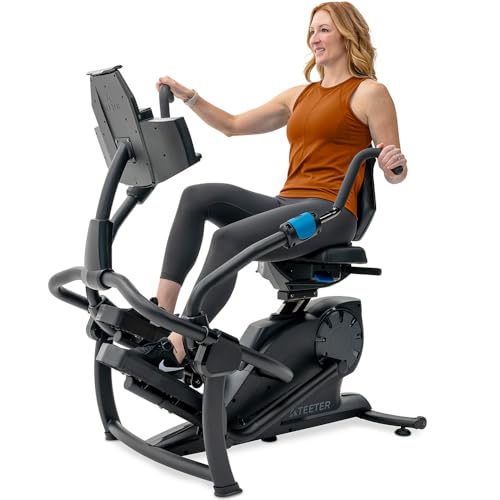
Teeter FreeStep Review Summary
The Teeter FreeStep is worth considering when ordinary cycling motion feels limiting or uncomfortable.
Teeter says its natural stepping path is easier on the joints and back than typical recumbent bikes or cross trainers, while the dual-power motion lets you work both arms and legs from a supportive seated position.
That combination suits older adults, people returning to exercise, and users who want a home cardio machine with more muscle involvement than a standard bike.
It is also a practical choice for households that value guided training.
The console includes 21 goal-based workouts and seven tracking metrics, while the subscription-free Teeter Move app adds classes across different lengths, experience levels, and session types.
The main tradeoff is that this is a substantial, feature-rich exercise machine rather than a compact pedal exerciser, and buyers who prefer standing workouts or a simple cycling experience may be better served elsewhere.
Review Scorecard
| Category | Score | Editorial assessment |
|---|---|---|
| Joint-friendly design | 9/10 | Seated stepping and a patented natural stride are built around reduced stress on joints and back. |
| Full-body engagement | 9/10 | Independent upper- and lower-body motion supports arm-only, leg-only, or combined training. |
| Resistance control | 8/10 | Twenty magnetic levels and console quick-keys provide useful progression without friction-based operation. |
| Comfort and access | 8/10 | The large adjustable seat, electronic step lock, grip pedals, and coated handles support longer sessions. |
| Workout guidance | 8/10 | The console offers 21 preset programs and the free app supplies a broad class library. |
| Home convenience | 8/10 | Quiet bearings, cup holders, a media rack, USB charging, transport wheels, and included assembly support add utility. |
For shoppers comparing a Teeter FreeStep review with conventional cardio equipment, its strongest argument is not maximum intensity.
It is the ability to make consistent exercise feel more approachable while still involving the upper body.
Key Features and Specifications of Teeter FreeStep
The defining feature is the patented physical therapy stride.
Rather than asking the user to pedal in a circular motion, the FreeStep uses a natural stepping movement in a seated position.
The manufacturer describes it as a home-use version of the gentle exercise found in commercial physiotherapy steppers.
That design is intended to ease strain on the hips, knees, ankles, and back.
The machine’s dual-power motion connects the handles and pedals for a total-body workout.
You can use both together to distribute exertion across more muscle groups, or isolate the legs or arms to vary a session.
That flexibility matters for buyers who want to adjust training based on comfort, fatigue, or rehabilitation goals.
Resistance is magnetic, with 20 levels and console quick-keys covering a stated range from 0 to 105 pounds of resistance.
Magnetic operation is designed to be friction-free and quiet, and Teeter pairs it with UltraGlide bearings for smoother starts and stride transitions.
The listing specifically positions the FreeStep as quiet enough for workouts at any time of day.
The console provides a 9-inch color LCD screen, seven tracking metrics, and 21 pre-programmed goal-based workouts.
Bluetooth heart-rate monitoring is supported, although the heart-rate monitor is sold separately.
A height-adjustable media rack holds a phone or tablet, and the USB charging port can help keep a device powered during a class or longer workout.
Comfort and access receive considerable attention.
The Extra-Large ComfortMax seat offers multiple positioning options, while the SoftStep pedals have a durable grip surface for traction and control.
SureGrip handles use a polyurethane coating intended for durability.
An electronic step lock helps with entry and exit, and dual cup holders keep water or small personal items within reach.
The product is rated for users from 4 feet 11 inches to 6 feet 6 inches and supports up to 350 pounds.
Transport wheels assist with repositioning.
Assembly is described as frustration-free with the BILT app, and the brand provides US-based support.
The included Teeter Move personal training app is compatible with iOS and Android and is presented as subscription-free.
Pros and Cons of Teeter FreeStep
Pros
- Joint-conscious motion: The seated stepping path is designed to reduce stress compared with cycling and other common cardio movements.
- More than a leg workout: Dual-power operation engages the upper and lower body, with arm-only and leg-only options.
- Broad resistance range: Twenty magnetic levels allow gradual changes for easier starts and more demanding sessions.
- Useful built-in guidance: Twenty-one goal-based workouts and seven metrics make the console more purposeful than a basic display.
- Comfort-focused contact points: The large seat, adjustable positioning, grippy pedals, and coated handles address the parts of the machine used most.
- Quiet home operation: Magnetic resistance and UltraGlide bearings are intended to provide low-noise, fluid movement.
- No-cost app access: Teeter Move supplies trainer-led classes without a subscription, according to the listing.
Cons
- Not a compact machine: The combination of a large seat, moving arms, and stepper mechanism requires a dedicated home location.
- Heart-rate accessory is separate: Bluetooth compatibility is available, but the compatible HRM is not included.
- A different movement pattern: Buyers who specifically want the familiar circular pedal motion of a recumbent bike may need an adjustment period.
- Potentially more machine than casual users need: If your goal is occasional light movement with minimal setup, the FreeStep’s console and full-body mechanism may be unnecessary.
- Listing-based assessment: The available evidence describes the design and manufacturer claims; it does not document independent testing or hands-on use.
Who Should Buy Teeter FreeStep?
The best fit is someone who wants regular cardio but is concerned about impact on the knees, hips, ankles, or back.
The seated position and physical-therapy-inspired stride are particularly relevant for people with arthritis, Parkinson’s, or MS, conditions the listing identifies as potential use cases.
Those buyers should still follow advice from a qualified clinician about appropriate exercise.
It also makes sense for users who want a more complete workout than a recumbent bike typically provides.
The ability to combine arm and leg motion, or isolate either end of the body, gives the FreeStep more programming flexibility.
Beginners can start with low resistance and preset programs, while more experienced users can use the 20-level range to build progression.
Skip it if you need equipment that folds away, fits under a desk, or can be moved effortlessly after every session.
It is also a weaker match for athletes seeking standing, high-impact, or sport-specific conditioning.
Finally, if you strongly prefer a simple pedal cycle and have no need for upper-body movement, a conventional recumbent bike may be more intuitive.
How the Teeter FreeStep Fits Joint-Friendly Home Cardio
Stepping versus cycling
The FreeStep’s key distinction is its stepping path rather than a circular pedal stroke.
Teeter presents that alignment as easier on the hips, knees, and ankles than typical recumbent bikes or cross trainers, making movement pattern an important buying factor.
Total-body effort without standing
The handles and pedals work together to spread exertion across the upper and lower body while the user remains seated.
That can make a session feel more comprehensive without requiring the balance and weight-bearing demands of a standing elliptical.
Progression for inconsistent exercisers
Twenty magnetic resistance levels, preset goals, and app classes create several ways to build a routine.
A user can choose a short guided class, adjust resistance from the console, or focus on one body region when a full-body session is not appropriate.
Comfort as a consistency feature
The large seat, entry-and-exit step lock, pedal traction, cup holders, and media rack are not just decorative extras.
They reduce small barriers that can otherwise make home exercise harder to repeat, especially for users who need a stable, supported setup.
Alternatives to Teeter FreeStep
If you want the same general category but a different movement style, compare the Schwinn 270 Recumbent Bike for a conventional seated cycling experience and a familiar recumbent-bike layout.
It may appeal more to buyers who prefer circular pedaling and established bike-style controls.
For a standing full-body trainer, consider the Nautilus E618 Elliptical Trainer.
An elliptical can provide arm-and-leg motion with a different stride and posture, but it is less aligned with the FreeStep’s seated, access-focused design.
Those seeking a simpler recumbent option can also look at the Marcy Recumbent Exercise Bike.
It is a better direction when basic seated cycling is the priority and you do not need the FreeStep’s stepping motion, upper-body involvement, or trainer-app ecosystem.
Is Teeter FreeStep Worth It?
The Teeter FreeStep is a strong choice for buyers who put joint-friendly movement, seated comfort, and total-body engagement ahead of compactness or traditional cycling.
Its 20-level magnetic resistance, preset workouts, subscription-free app, supportive seat, and access features create a well-rounded home cardio proposition.
Is Teeter FreeStep worth it? For a user who wants a low-impact, seated alternative that can involve both arms and legs, yes.
Choose it when the patented stepping motion and comfort-focused design match your needs; choose a recumbent bike or compact exerciser when simplicity, smaller storage, or circular pedaling matters more.
Bottom line: The Teeter FreeStep is best suited to consistent, joint-conscious home exercise, especially for people who want guided workouts and more than a leg-only cardio routine.