The best stability balls for core training can make familiar exercises more challenging while supporting balance, posture, and controlled movement. The right choice depends on your height, workout style, available space, and how much stability or instability you want.
This roundup compares 10 options, from full-size anti-burst exercise balls to compact half-ball trainers and balance discs, so you can match the equipment to your routine.
Best 10 Stability Balls for Core Training Picks for 2026
Best Half-Ball Platform
Horizon Half Balance Ball Trainer

- Reversible dome-up and base-up design
- 440-pound capacity with textured footing
- Includes pump, Pilates ball, and accessories
Best For: Versatile home balance and core training
Best Full-Size Value

- Frosted, anti-slip surface
- Supports up to 330 pounds
- Multiple sizes with pump included
Best For: All-purpose core, yoga, and Pilates workouts
Best Compact Option
ProsourceFit Core Balance Disc

- Portable 14-inch balance platform
- Dual-textured, non-slip surfaces
- Includes hand pump and supports 300 pounds
Best For: Small-space training and active sitting
Best Training-App Bundle

- Supports core, balance, and mobility drills
- Deflatable anti-slip vinyl construction
- Includes access to 500-plus guided workouts
Best For: Structured training with guided workout programming
Most Stable Half-Ball Platform
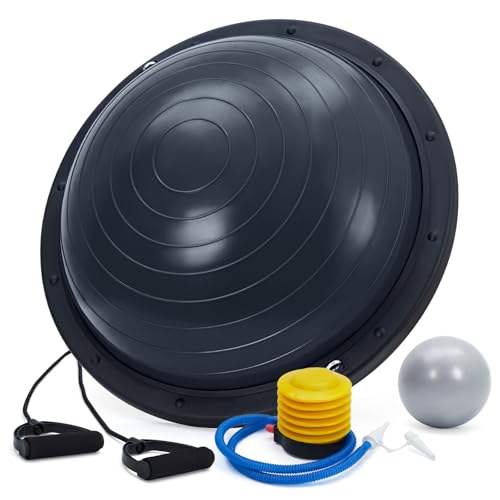
- Textured dome with ABS base and six grip feet
- Includes detachable resistance bands and pump
- Comes with a bonus 10-inch yoga ball
Best For: Home users seeking a supported half-ball trainer for core and full-body workouts
Best Size Selection
APEXUP Anti-Burst Exercise Ball

- Five sizes range from 45 to 85 cm
- Honeycomb PVC supports up to 660 pounds
- Includes pump and two air plugs
Best For: Users wanting a traditional stability ball with flexible sizing
Best for Versatile Daily Use

- Five sizes are matched to user height
- 880-pound anti-burst PVC construction
- Includes pump, plugs, remover, and exercise guide
Best For: Users seeking one ball for core training, active sitting, or mobility work
Best for Instability Training

- Textured ball and nonslip base
- Includes two resistance bands and pump
- 1,500-pound maximum weight recommendation
Best For: Core balance work and posture-focused home workouts
Best Versatile Full Ball

- Anti-burst material for workouts
- Includes pump and stabilizing base
- Suitable for yoga, core work, and office use
Best For: Full-ball training, stretching, and pregnancy support
Best for Full-Body Training

- Supports planks, lunges, push-ups, and step work
- Includes resistance bands and foot pump
- Compact design for storage or travel
Best For: Full-body balance, strength, and rehabilitation exercises
Best Half-Ball Platform – Horizon Half Balance Ball Trainer
For shoppers comparing stability balls for core training, the Lifepro Horizon stands out as a reversible half-ball platform with a broad 23.6-inch base. Its textured surface, 440-pound capacity, included pump, and two-sided setup make it suitable for controlled home workouts ranging from planks to squats.
Best For: Beginners, home gym users, seniors, and anyone who wants both dome-up and base-up balance training.
Pros:
- Reversible design provides two training modes.
- Textured, non-slip surface supports steady footing.
- Supports up to 440 pounds and includes an air pump, Pilates ball, and accessories.
- Backed by lifetime support.
Cons:
- The half-ball format offers a different workout feel than a full-size stability ball.
- At 6.8 kg, it is less lightweight than a compact balance disc.
The Horizon is a versatile choice if you want a stable platform for core and full-body exercises, especially when adjustable challenge and footing confidence matter more than compact storage.
Best Full-Size Value – Trideer Yoga Exercise Ball
The Trideer Yoga Ball is a practical full-size option for stability balls for core training, yoga, Pilates, and flexibility work. Its frosted, anti-slip surface is designed to maintain contact with the floor and body, while multiple size options help accommodate different users.
Best For: Users seeking a versatile exercise ball for core workouts, yoga, Pilates, stretching, or active sitting.
Pros:
- Anti-slip stripes and frosted texture promote controlled movement.
- Burst-resistant construction supports up to 330 pounds.
- Available in five sizes for different body types and goals.
- Includes a pump, two air stoppers, and instructions.
Cons:
- The supplied listing identifies the included pump type by size, so setup may vary.
- Its full-size design requires more storage space than a disc or half-ball trainer.
With broad activity coverage and several size choices, the Trideer is a sensible all-purpose pick for shoppers who want one ball for exercise, mobility work, and posture-focused sitting.
Best Compact Option – ProsourceFit Core Balance Disc
If you want stability balls for core training without storing a large exercise ball, the ProsourceFit Core Balance Disc is a compact alternative. Its 14-inch platform creates an unstable surface for balance work, doubles as a seat cushion, and includes a hand pump for adjusting firmness.
Best For: Small spaces, portable workouts, balance practice, and active sitting for posture and balance.
Pros:
- Compact 14-inch design is easy to transport.
- Dual-textured sides provide different surface feels.
- Raised bumps offer a massaging texture, while the smoother side supports grip.
- Supports up to 300 pounds and includes a hand pump.
Cons:
- The small disc does not provide the full range of seated or lying exercises available from a full-size ball.
- Its 3-inch height is intended for balance work rather than large-ball movements.
This disc is a strong choice when portability and storage matter most. It delivers core and balance engagement in a smaller format and can also serve as an active seat cushion.
Best Training-App Bundle – TRX Stability Ball
TRX Training Stability Ball for Improving Posture and Core Strength, Yoga Ball for Gym, 55 cm
Check Price On AmazonThe TRX Stability Ball combines a conventional 55 cm exercise ball with access to TRX Training Club workouts. For stability balls for core training, it supports crunches, planks, squats, balancing drills, mobility work, and full-body coordination exercises, while its deflatable vinyl construction makes it easier to pack away.
Best For: Users who want a traditional stability ball plus guided workout programming for strength, mobility, sport, or rehabilitation-focused training.
Pros:
- Supports a wide variety of core, balance, flexibility, and coordination exercises.
- Durable anti-slip vinyl is designed for repeated use.
- Deflates for easier transport and storage.
- Includes access to TRX Training Club’s 500-plus on-demand workouts.
Cons:
- Ships deflated, so inflation is required before use.
- The supplied details list a 55 cm size, with the 65 cm option described separately for taller users.
- The app experience may be more than needed for shoppers seeking only a basic exercise ball.
The TRX is a good fit for structured training rather than casual use alone. Its exercise range and included app access add value for users who want guided sessions alongside the ball.
Most Stable Half-Ball Platform – Garvee Half Balance Ball
For shoppers comparing stability balls for core training, the Garvee Half Balance Ball offers a supported dome platform rather than a fully round ball. Its textured PVC surface, ABS base, and six grip feet are designed to help keep the trainer steady during balance and strength exercises.
Best For: Home users who want a stable half-ball trainer with resistance bands and accessories for varied full-body workouts.
Pros:
- Textured non-slip dome and ABS base provide a secure training platform.
- Includes two detachable resistance bands with foam handles.
- Supports core work, balance drills, squats, lunges, push-ups, sit-ups, and yoga.
- Includes a pump and bonus 10-inch yoga ball.
Cons:
- Its half-ball design provides a different training experience from a conventional full exercise ball.
- At 23 inches and 11.9 pounds, it may be less convenient to move than a lightweight full ball.
The Garvee is a strong pick if stability and exercise variety matter more than traditional ball-based sitting or stretching. The included bands and bonus ball also make it a comprehensive home-gym package.
Best Size Selection – APEXUP Anti-Burst Exercise Ball
The APEXUP is a conventional full-size option for shoppers comparing stability balls for core training. Its honeycomb PVC construction is designed to deflate slowly if punctured, while the textured surface helps improve grip during balance, Pilates, stretching, and strengthening exercises.
Best For: Adults who want a traditional exercise ball with multiple size choices, anti-burst construction, and a pump included.
Pros:
- Available in five sizes from 45 to 85 cm to accommodate different users.
- Honeycomb PVC is rated to support up to 660 pounds and deflates slowly if punctured.
- Textured surface helps provide grip on hard floors.
- Can be used for core training, Pilates, stretching, or active sitting.
Cons:
- Choosing the correct size requires checking the provided size guide.
- The supplied details list a pump and air plugs but do not mention a printed exercise guide.
With its broad size range and multipurpose design, the APEXUP is a flexible choice for home gyms and workout spaces. Select the diameter carefully so the ball matches your height and intended use.
Best for Versatile Daily Use – ProBody Pilates Yoga Ball
The ProBody Pilates Yoga Ball combines size-specific fitting with gym-grade PVC for stability balls for core training. It is designed for core, lower-back, and pelvic-floor engagement, while also supporting active sitting, Pilates, stretching, physical-therapy exercises, and prenatal mobility work.
Best For: Users who want a size-matched ball for core workouts, desk sitting, guided rehabilitation exercises, or prenatal and postpartum mobility.
Pros:
- Five size options are matched to different height ranges.
- Anti-burst PVC is tested to 880 pounds and is designed to deflate slowly if punctured.
- Includes a dual-action pump, two plugs, stopper remover, and printed exercise guide.
- Backed by a 12-month manufacturer promise according to the supplied notes.
Cons:
- The intentionally unstable design may require adjustment for first-time users.
- Users must allow the ball to settle after initial inflation before topping it up.
- Prenatal and rehabilitation use should be confirmed with an appropriate healthcare professional.
The ProBody stands out for its broad use case and detailed setup guidance. Its size range and included accessories make it a practical option when one ball needs to serve workouts, active sitting, or low-impact mobility routines.
Best for Instability Training – Zelus Half Balance Ball
For shoppers comparing stability balls for core training, the Zelus Balance Ball stands out as a half-ball trainer designed to add controlled wobble to workouts. Its textured surface, nonslip base, included resistance bands, and foot pump support balance, strength, yoga, and cardio exercises.
Best For: Core-focused balance work, posture training, and users who want resistance bands included.
Pros:
- Textured PVC ball and anti-slip TPR base help maintain traction and control.
- Includes two exercise bands with cushioned grips for added arm and core exercises.
- Includes a foot pump for faster inflation.
- Rated for a 1,500-pound maximum weight recommendation.
Cons:
- The half-ball design is less suitable than a full ball for seated or pregnancy-focused use.
- Its 25-by-25-inch footprint requires dedicated floor space.
The Zelus is a practical pick when your priority is a stable platform with enough instability to challenge balance and core control. The bands and pump make it a well-equipped option for home workouts.
Best Versatile Full Ball – Retrospec Luna Exercise Ball
The Retrospec Luna is a full-size option for shoppers seeking stability balls for core training, stretching, yoga, or everyday sitting. Its anti-burst construction, nonslip surface, included pump, and base make it adaptable for home gyms, office use, and pregnancy-related support.
Best For: Full-ball core exercises, gentle mobility work, desk-chair alternatives, and pregnancy use.
Pros:
- Thick anti-burst material is designed for intense workouts.
- The nonslip surface helps provide steadiness during exercise or seated use.
- Includes a pump and base for added versatility and stability.
- 65-centimeter size and 1,000-pound capacity suit a range of activities.
Cons:
- As a full exercise ball, it needs more room to roll and position than a half-ball trainer.
- The included base may limit some exercises that require unrestricted ball movement.
The Luna is the more flexible choice if you want one ball for core training, stretching, office sitting, and pregnancy support. Its included stand adds convenience, while the full shape allows a broad range of movements.
Best for Full-Body Training – VEVOR Half Exercise Ball
The VEVOR Half Exercise Ball is a compact choice for stability balls for core training and broader strength routines. Its half-ball format supports exercises such as planks, lunges, push-ups, and step work, while the included resistance bands and foot pump expand its home-gym uses.
Best For: Full-body workouts, balance drills, rehabilitation-oriented training, and portable home-gym setups.
Pros:
- Supports multiple movements, including stepping, planks, lunges, and push-ups.
- Includes resistance bands and professional inflation tools.
- Explosion-proof construction is designed to withstand pressure and impact.
- Compact, lightweight design is convenient for storage and travel.
Cons:
- The listed 660-pound maximum weight recommendation is lower than the 1,500-pound claim in the product title.
- Its 23-inch class size provides less surface area than a full exercise ball.
The VEVOR makes sense for users who want a half-ball platform that can move beyond core work into balance, strength, and rehabilitation exercises. Its compact form and included accessories are useful for flexible training spaces.
How We Picked the Best Stability Balls for Core Training
We compared these products by looking at construction, stated weight capacity, surface grip, inflation requirements, included accessories, size options, and the type of training each design supports. We also considered how practical each ball is for home gyms, offices, stretching, Pilates, pregnancy workouts, balance drills, and progressive core exercises.
Because product formats vary, this list includes both full-size Swiss balls and half-ball trainers. They are not interchangeable: a full ball is useful for seated exercises, hamstring curls, planks, and mobility work, while a half ball or balance disc generally provides a more stable base and a smaller footprint.
Quick Comparison
- Full-size exercise balls: Trideer, APEXUP, ProBody, Retrospec Luna, and TRX options suit general fitness, stretching, Pilates, seated work, and core exercises.
- Half-ball trainers: Lifepro, Garvee, ZELUS, and VEVOR models are better suited to balance training, squats, planks, lunges, and instability drills.
- Compact balance equipment: The ProsourceFit balance disc is convenient for seated posture work, ankle training, and small-space routines.
Key Buying Factors for Stability Balls for Core Training
Size and Fit
Choose a ball that lets your knees remain roughly level with or slightly below your hips when seated. Common full-ball sizes range from about 45 to 75 centimeters, but height, leg length, and intended use matter. Check the manufacturer’s sizing chart rather than relying on diameter alone.
Shape and Stability
Full balls move in multiple directions and demand more control. Half balls and discs offer a defined base, making them easier to position for balance drills while still challenging the core. A non-slip base is especially useful on hard floors.
Capacity and Construction
Look for anti-burst materials, reinforced seams, and a clearly stated weight capacity. Capacity includes your body weight plus any dumbbells or other equipment used during exercise. A higher rating does not automatically mean a ball is better, but it can provide additional margin for loaded movements.
Inflation and Accessories
An included pump adds convenience, while a removable plug and compatible replacement parts make long-term maintenance easier. Inflate gradually and follow the recommended diameter; overinflation can change the ball’s feel and reduce control.
Who Should Buy Which Stability Balls for Core Training?
Choose a full-size ball if you want one versatile tool for core work, stretching, Pilates, seated exercises, or home-office use. Choose a half-ball trainer if your priority is balance, standing strength work, or a more compact setup. Choose a balance disc if storage space is limited or you want a portable option for seated stability and lower-body drills.
Beginners may prefer a design with a broad base or textured surface, while experienced users can select a more reactive ball for planks, single-leg work, and advanced balance challenges. Whichever format you choose, use it on a clear, non-slip surface and progress gradually.