Small rooms need cooling that fits without creating more noise, clutter, or heat. The best tower fans for small rooms combine a narrow footprint with useful airflow, quiet operation, and controls that are easy to use from bed or a desk.
We compared 10 compact and full-height models across airflow, sound levels, oscillation, controls, timers, portability, and overall convenience to help you choose the right fan for a bedroom, office, dorm, or other space-constrained room.
Best 10 Tower Fans for Small Rooms Picks for 2026
Best High-Velocity Pick

- Airflow up to 28 ft/s
- 31 dB operation with Sleep Mode
- Eight speeds and 90° oscillation
Best For: Small rooms needing strong, customizable airflow
Best Compact Desk Option
Honeywell QuietSet Personal Fan

- Compact 13-inch design
- Four sound-and-power levels
- Oscillates for personal cooling
Best For: Desks and nightstands in space-constrained rooms
Best Smart Comfort Controls
Levoit Classic 36-Inch Tower Fan

- 28 dB low-speed operation
- Temperature-sensing Auto Mode
- 12-hour timer and remote control
Best For: Quiet bedrooms needing automatic airflow adjustments
Best Portable Quiet Pick

- Quiet 28 dB operation
- Airflow up to 26 ft/s
- Portable design with 90° oscillation
Best For: Bedrooms and offices needing quiet, movable cooling
Best Quiet Mini Fan

- 20–43 dB listed noise range
- Compact 13-inch tabletop design
- Adjustable 30°, 60°, or 90° oscillation
Best For: Small bedrooms, desks, and home offices
Best Simple Floor Model
Amazon Basics 28-Inch Tower Fan

- Three push-button speed settings
- 60-degree oscillation
- Slim 9.4-inch-wide floor design
Best For: Bedrooms, offices, and simple everyday cooling
Quiet Bedroom Pick
DR.PREPARE 16-Inch DC Tower Fan

- 25 dB quiet operation with eight speeds
- Remote, touchscreen, timer, and 80° oscillation
- Compact tabletop design with cleanable components
Best For: Bedrooms and home offices needing quiet, adjustable cooling
Wide-Breeze Value
Dr. Prepare 13-Inch Dual-Fan Tower
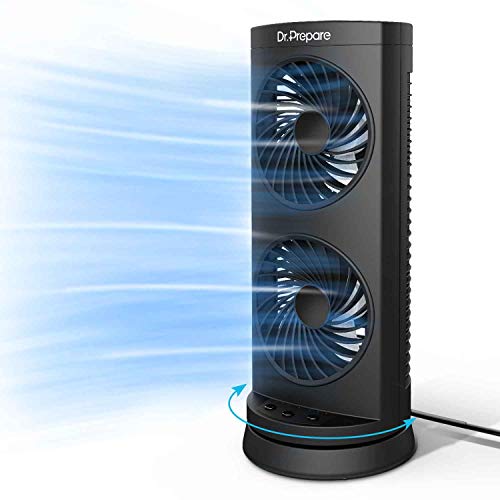
- Dual-fan airflow with 110° oscillation
- Three speeds and three auto-off timer options
- Compact 13-inch tabletop form
Best For: Desks, dorm rooms, and small spaces needing broad personal airflow
Smart Compact Choice

- Four speeds, four modes, and AI mode
- 28 dB operation with remote and 12-hour timer
- Lightweight 13.2-inch bladeless design
Best For: Bedrooms and desks needing portable, feature-rich cooling
Best High-Velocity Pick – DREO 28 ft/s Tower Fan
For shoppers comparing tower fans for small rooms, this DREO model combines strong airflow with a slim, freestanding design. Its brushless DC motor reaches up to 28 ft/s, while eight speeds, four modes, 90-degree oscillation, and remote or touch controls make it easy to tailor cooling.
Best For: Small bedrooms, offices, and living spaces where powerful airflow and flexible controls matter.
Pros:
- High-velocity airflow reaching up to 28 ft/s and projecting up to 34 feet
- Quiet 31 dB operation with a dedicated Sleep Mode
- Eight speeds, four modes, 90-degree oscillation, remote, and touch controls
- Removable rear grille and impeller support easier cleaning
Cons:
- At 36.22 inches tall, it may be larger than needed for very tight spaces
- Offers more settings than shoppers seeking basic, single-button cooling may need
This is a feature-rich choice when a small room needs noticeable air circulation without giving up nighttime usability. The 12-month warranty can be extended to 30 months through registration.
Best Compact Desk Option – Honeywell QuietSet Personal Fan
If floor space is limited, this compact Honeywell fan is a practical alternative to full-size tower fans for small rooms. The 13-inch design fits on desks and nightstands, provides oscillation, and offers four sound-and-power levels for personal cooling.
Best For: Desks, nightstands, bedrooms, and other spaces where a compact personal fan is more useful than a tall tower.
Pros:
- Small 13-inch footprint for desks and nightstands
- Four sound-and-power levels for adjustable comfort
- Oscillation and quiet operation for personal cooling
- Lightweight 2-pound design
Cons:
- Provides personal rather than whole-room cooling
- Uses button controls instead of a remote
- No listed timer or advanced operating modes
This is best viewed as a space-saving personal fan rather than a conventional floor tower. Its compact size makes it especially suitable when a small room cannot accommodate a 36-inch model.
Best Smart Comfort Controls – Levoit Classic 36-Inch Tower Fan
This Levoit tower fan suits shoppers who want quiet, adaptable cooling in a small bedroom or office. It combines airflow up to 28 ft/s with five speeds, four modes, wide oscillation, a temperature-sensing Auto Mode, remote control, and a 12-hour timer.
Best For: Bedrooms and offices where low-noise operation, automatic adjustments, and scheduled cooling are priorities.
Pros:
- Near-silent 28 dB operation on low speed
- Auto Mode adjusts airflow using a built-in temperature sensor
- Five speeds, four modes, remote control, and a 12-hour timer
- Slim 6.5-inch by 6.5-inch footprint with oscillation
Cons:
- At 36.2 inches tall, it still requires dedicated floor space
- Its broad feature set may be more than needed for basic cooling
The Levoit stands out for making nighttime and everyday cooling easier to automate. Its 28 dB low-speed rating and timer are particularly useful for light sleepers, while the narrow footprint works well in compact rooms.
Best Portable Quiet Pick – DREO 26 ft/s Tower Fan
For small rooms that need a slim fan with easy portability, this DREO model delivers airflow up to 26 ft/s while maintaining a 28 dB noise rating. Its 90-degree oscillation, four speeds, three modes, remote, and touch controls provide straightforward flexibility.
Best For: Bedrooms, kids’ rooms, and home offices where quiet operation and a portable tower profile are important.
Pros:
- Quiet 28 dB operation suited to sleeping or focused work
- Airflow reaches up to 26 ft/s and projects up to 33 feet
- 90-degree oscillation, four speeds, and three modes
- Slim, lightweight profile designed for portability
Cons:
- Has fewer speeds and modes than some similarly sized models
- The supplied details do not list a timer
This model is a sensible fit when low noise and easy repositioning matter more than extensive automation. Its 36-inch height keeps the tower format while the portable design helps it adapt to changing room layouts.
Best Quiet Mini Fan – Levoit Windi Mini Tower Fan
For shoppers comparing tower fans for small rooms, the Levoit Windi Mini is a compact tabletop option designed for bedrooms, offices, and other space-limited areas. Its DC motor, 20–43 dB noise range, and low 7.5-watt maximum draw make it practical for quiet, extended use.
Best For: Small bedrooms, desks, home offices, and anyone prioritizing quiet operation and portability.
Pros:
- Compact 13-inch tabletop design with a soft carrying handle.
- Quiet operation rated from 20–43 dB, with sound and display-off functions.
- Five power levels, Turbo mode, and adjustable 30-, 60-, or 90-degree oscillation.
- Strong airflow with a maximum listed draw of 7.5 watts.
Cons:
- Must remain plugged into an outlet; it is not cordless.
- Its tabletop format is intended for personal airflow rather than broad floor-level circulation.
The Levoit Windi Mini stands out when quiet personal cooling and easy movement matter more than whole-room coverage. Its small footprint and flexible oscillation make it a useful fit for compact spaces.
Best Simple Floor Model – Amazon Basics 28-Inch Tower Fan
The Amazon Basics 28-inch tower fan is a straightforward choice for shoppers seeking tower fans for small rooms without complex controls. Its slim floor-standing design, three speeds, and 60-degree oscillation provide basic cooling and air circulation for bedrooms, offices, and living spaces.
Best For: Buyers who want simple push-button controls and a compact floor fan for enclosed indoor spaces.
Pros:
- 28-inch tower measures 9.4 inches deep by 9.4 inches wide.
- Three speed settings allow basic airflow adjustment.
- 60-degree oscillation helps distribute air across the room.
- Top-mounted mechanical controls are easy to operate.
Cons:
- No timer or remote control is listed in the supplied specifications.
- Uses a 35-watt design in the product title, while the detailed listing specifies 100 watts.
- Provides fewer speed options than some competing models.
This model favors uncomplicated operation over extra features. It is a sensible pick for a small room where a freestanding tower, basic speed control, and oscillation are the main priorities.
Best Timed Cooling – PELONIS 30-Inch Oscillating Tower Fan
The PELONIS 30-inch tower fan combines a slim floor-standing profile with three speeds, quiet operation rated at 30 dB, and wide-angle oscillation. For tower fans for small rooms, its built-in timer and lightweight design add useful convenience for bedrooms, apartments, dorm rooms, and offices.
Best For: Small-space users who want adjustable airflow, broad oscillation, and scheduled cooling.
Pros:
- Space-saving 6.8-inch-deep by 7-inch-wide design with a built-in handle.
- Three speed settings provide gentle to stronger airflow.
- 90-degree oscillation helps distribute air across the room.
- 20-minute timer increments can be set for up to 120 minutes.
Cons:
- Only three speed settings are available.
- The timer is limited to 120 minutes.
- No remote control is listed in the supplied details.
The PELONIS is a practical middle ground for compact rooms: slimmer than many floor fans, yet tall enough to circulate air beyond a desktop. Its timer makes it especially useful when you want cooling without leaving the fan running indefinitely.
Quiet Bedroom Pick – DR.PREPARE 16-Inch DC Tower Fan
For shoppers comparing tower fans for small rooms, this compact DR.PREPARE model emphasizes quiet operation, adjustable airflow, and convenient bedroom controls. Its 16-inch tabletop design uses a 12W DC motor, offers eight speeds, and oscillates across 80 degrees.
Best For: Bedrooms, home offices, and sleepers who want low-noise cooling with remote control.
Pros:
- Runs as quietly as 25 dB and provides eight speed settings.
- Remote and touchscreen controls manage speed, oscillation, modes, and timer.
- Offers 1–8-hour timing, 80-degree oscillation, and a detachable impeller wheel and rear guard for cleaning.
Cons:
- Its 16-inch height may provide less reach than a full-size floor tower fan.
- It requires corded electric power and is intended for indoor use.
This is a strong small-room option when quiet performance and precise control matter most. The compact footprint and efficient DC motor suit bedside or desktop placement, while the eight speeds make it easier to fine-tune airflow.
Wide-Breeze Value – Dr. Prepare 13-Inch Dual-Fan Tower
This 13-inch Dr. Prepare model is a practical choice among tower fans for small rooms when broad personal airflow is the priority. Its dual-fan design, three speed options, and 110-degree oscillation help distribute air across a desk, bedside area, or compact office.
Best For: Desks, bedside tables, dorm rooms, and small offices that need wide oscillation.
Pros:
- Dual fans and 110-degree oscillation help cover a wider area.
- Three speed settings provide simple, straightforward control.
- Includes 2-, 4-, and 8-hour auto-off timers and uses a 16W motor.
Cons:
- It has fewer speeds and controls than the other models in this roundup.
- Noise is rated below 60 dB, so it may not be the quietest option for light sleepers.
- Control is by push buttons rather than a remote.
Choose this fan if coverage is more important than advanced controls. The 110-degree sweep and dual-fan layout are useful for circulating air around a compact space, while its 13-inch tabletop size remains easy to place.
Smart Compact Choice – PNTCK 13.2-Inch Bladeless Fan
For tower fans for small rooms with modern controls, the PNTCK combines a 13.2-inch tabletop footprint with four speeds, four modes, remote operation, and a 12-hour timer. Its 70-degree oscillation and claimed 28 dB quiet operation make it suitable for bedrooms, desks, and other compact indoor spaces.
Best For: Users who want a portable, remote-controlled fan with multiple modes and a bladeless design.
Pros:
- Provides four speeds, four modes, 70-degree oscillation, and a 12-hour timer.
- Operates as quietly as 28 dB and includes remote control.
- At about 13 inches tall and 3 pounds, it is easy to move and place on a desk or nightstand.
Cons:
- Its 70-degree oscillation is narrower than the 110-degree range of the dual-fan model.
- The supplied details do not specify a detachable grille or other cleaning components.
- It is primarily listed for bedroom use, so placement options may be more limited than models specified for several room types.
This PNTCK fan stands out for its combination of portability, quiet operation, and flexible controls. The AI mode, remote, and longer timer add convenience, while the compact bladeless design works well where space is limited.
How We Picked the Best Tower Fans for Small Rooms
We focused on features that matter most when floor space and noise tolerance are limited. Each selected fan was evaluated for its physical footprint, airflow claims, speed settings, oscillation range, timer options, control method, portability, and suitability for sleeping or working. We also included both full-height tower fans and compact personal models because a small room does not always need room-wide circulation.
Noise ratings were treated as useful reference points rather than guarantees. Actual sound depends on the selected speed, room acoustics, and how close the fan is to the bed or desk. Likewise, airflow specifications are most useful for comparing models within the same category, not as a promise of a specific room temperature.
Quick Comparison
- Best for maximum airflow: Choose a higher-velocity DREO or Levoit tower when you want stronger circulation from one floor-standing unit.
- Best for quiet bedrooms: Look for models advertising low-decibel operation, multiple speeds, and a sleep-friendly timer.
- Best for desks and nightstands: Personal fans from Honeywell, Levoit, Dr. Prepare, or PNTCK take up less space and target airflow more directly.
- Best for simple operation: The Amazon Basics mechanical-control model avoids remote and digital-control complexity.
- Best for flexible coverage: A wide oscillation range helps distribute air around a small room instead of cooling only one spot.
Key Buying Factors for Tower Fans for Small Rooms
Size and Placement
Measure the area beside a bed, desk, or dresser before buying. A tall tower uses little floor width but still needs clearance for intake and exhaust airflow. Compact desk fans are easier to place, though they usually cool a smaller area and may require a raised surface.
Noise and Nighttime Controls
For bedrooms, prioritize a low-speed setting, a published noise rating, and a timer. Remote controls are convenient when the fan is across the room, while simple buttons can be preferable if you want fewer electronic features. A display that can be dimmed or switched off is another useful sleep feature.
Airflow, Speeds, and Oscillation
More speed settings make it easier to balance cooling and noise. Oscillation is valuable in a small room because it spreads air across a wider section instead of creating one concentrated stream. Compare the stated oscillation angle and airflow claims, but consider them alongside the fan’s size and intended placement.
Power, Cleaning, and Controls
Most fans in this group are plug-in models, so place them near a suitable outlet without using a cord where it creates a trip hazard. Bladeless-style housings can be easier to wipe, but every fan still needs regular dust removal around its intake and grille. Check whether the controls are mechanical, electronic, or remote-operated before purchasing.
Who Should Buy Which Tower Fans for Small Rooms?
Choose a full-height tower if you want airflow from floor level across a bedroom or office and have a narrow spot available. Choose a compact personal fan if you mainly need cooling at a desk, bedside table, or dorm workstation. Choose a quiet, timer-equipped model for sleeping, especially if the fan will sit close to your bed. Choose a basic three-speed model if affordability and uncomplicated controls matter more than advanced settings. Finally, select a stronger multi-speed model if the room gets warm quickly or you want enough airflow to use the fan from several feet away.